
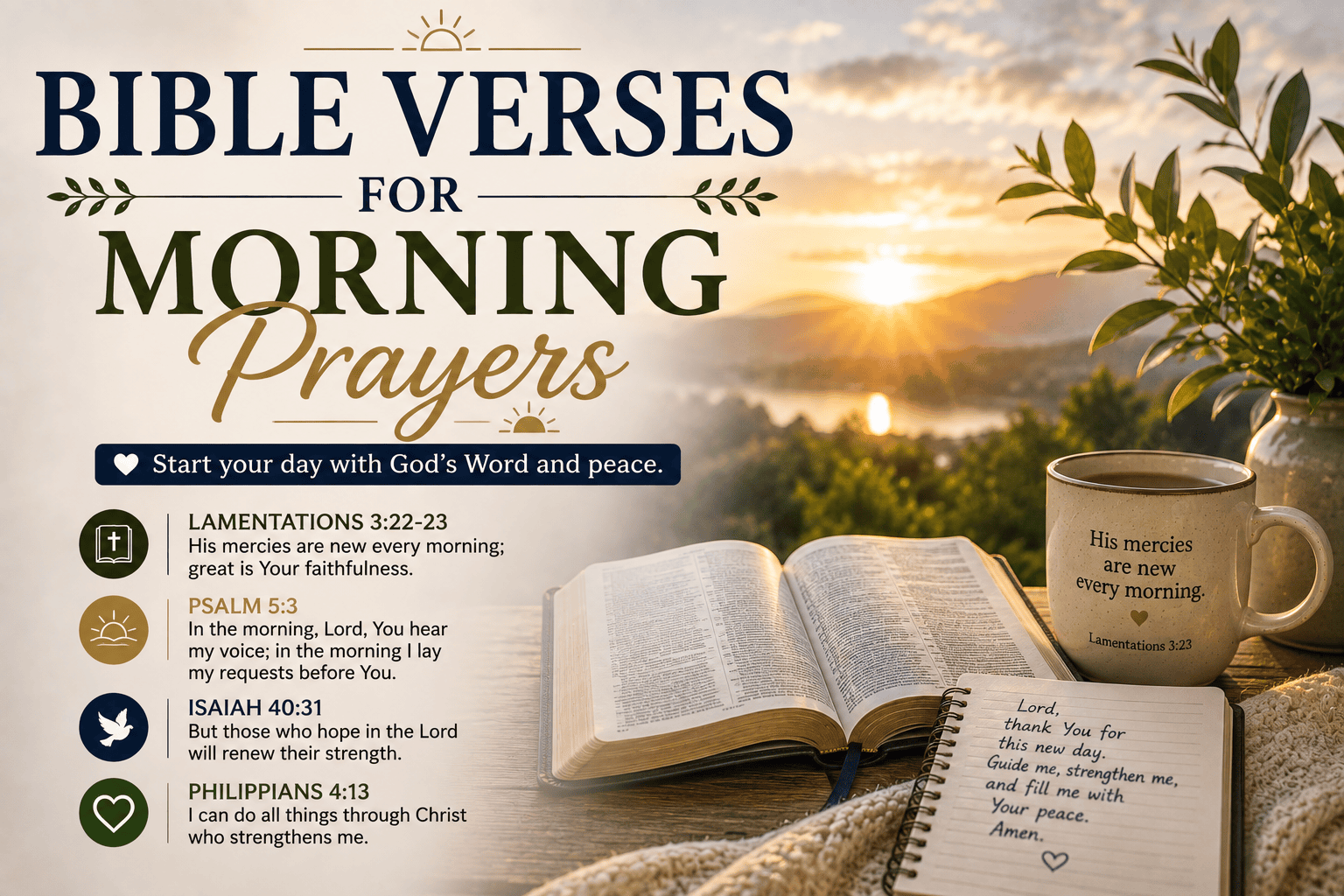
Starting the morning with Scripture can help Christians turn their attention toward God before the demands of the day begin. The Bible contains many passages that speak about seeking God, asking for guidance, giving thanks, trusting Him, and remembering His faithfulness.
If you are looking for Bible verses for morning prayers, the passages below offer a practical starting point. Some specifically mention morning prayer, while others address themes that naturally fit a morning devotional, such as gratitude, wisdom, peace, courage, and dependence on God.
You do not need a long prayer routine to begin. Choose one passage, reflect on its meaning, and use its central theme to guide your own words.
15 Bible Verses for Morning Prayers
1. Psalm 5:3 — Bring Your Prayer to God in the Morning
Psalm 5:3 is one of the clearest passages for a morning prayer routine. David describes bringing his prayer before the Lord in the morning and waiting expectantly.
Morning prayer focus: Begin the day by bringing your concerns, plans, and hopes to God rather than carrying them alone.
This verse also introduces an important part of prayer: waiting. Morning prayer is not only about presenting requests; it can also be a time of quiet attention and trust.
2. Psalm 143:8 — Ask God to Guide Your Steps
Psalm 143:8 connects morning devotion with trust and guidance. The psalmist asks to experience God’s steadfast love and to be shown the way he should go.
Morning prayer focus: Ask for wisdom about your decisions, responsibilities, relationships, and priorities.
A simple prayer based on this passage could be:
God, help me recognize Your faithful love today and guide me in the way I should go.
This is an original prayer based on the theme of the passage, not a quotation from Scripture.
3. Lamentations 3:22–23 — Remember God’s Faithfulness
Lamentations 3:22–23 emphasizes God’s steadfast love, compassion, and faithfulness, using the morning as an image of renewed mercy.
Morning prayer focus: Begin with gratitude instead of allowing yesterday’s difficulties to determine your outlook for today.
This passage can be especially meaningful when you are starting a new day after disappointment, uncertainty, or a difficult season.
4. Psalm 90:14 — Pray for Joy and Satisfaction
Psalm 90:14 asks God to satisfy His people with His steadfast love in the morning so that they may rejoice and be glad.
Morning prayer focus: Ask God to shape your priorities around what truly matters rather than depending entirely on circumstances for contentment.
The verse works well as part of a gratitude-focused morning devotional.
5. Psalm 118:24 — Give Thanks for a New Day
Psalm 118:24 points to rejoicing in the day that God has made.
Morning prayer focus: Thank God for the opportunity to live, serve, love, learn, and respond faithfully during the day ahead.
Instead of immediately focusing on everything that needs to be accomplished, pause and acknowledge the gift of a new day.
6. Mark 1:35 — Follow Jesus’ Example of Quiet Prayer
Mark 1:35 describes Jesus going to a solitary place early in the morning to pray.
This passage is significant because it provides a narrative example rather than simply an instruction about prayer. It shows Jesus intentionally making space for prayer before the activities of the day continued.
Morning prayer focus: Create a quiet moment to pray before distractions take over.
The point is not that every Christian must wake at a particular hour. Rather, the passage highlights intentional time with God.
7. Psalm 63:1 — Seek God Wholeheartedly
Psalm 63:1 expresses a deep desire for God and uses the imagery of seeking Him earnestly.
Morning prayer focus: Ask God to strengthen your desire to know Him and to keep your faith at the center of your day.
This passage can be especially appropriate when your morning prayer is more about worship and spiritual renewal than asking for specific things.
8. Psalm 19:14 — Ask for Words and Thoughts That Honor God
Psalm 19:14 is a prayer concerning both words and thoughts.
Morning prayer focus: Ask God to help you speak, think, and act in ways that are pleasing to Him.
This makes the verse particularly practical for a busy day. You can carry its theme into conversations, school or work, family responsibilities, and decisions.
9. Proverbs 3:5–6 — Trust God With Your Direction
Proverbs 3:5–6 encourages trust in the Lord rather than relying entirely on personal understanding and connects that trust with acknowledging God in one’s ways.
Morning prayer focus: Surrender your plans while asking for wisdom to make responsible decisions.
A morning prayer based on this passage can be especially helpful when you are facing an important decision or an uncertain schedule.
10. Isaiah 41:10 — Pray for Courage When You Feel Afraid
Isaiah 41:10 is a well-known passage about God’s presence, help, and strength.
Morning prayer focus: Bring fears and uncertainty before God and remember the biblical promise of His presence.
Rather than treating the verse as a guarantee that every difficulty will disappear, Christians can use it as a reminder to place their fears and dependence in God.
11. Philippians 4:6–7 — Bring Your Concerns to God
Philippians 4:6–7 teaches believers to bring their requests to God with prayer and thanksgiving. The passage also connects this practice with God’s peace.
Morning prayer focus: Name the concerns occupying your mind, thank God, and entrust those concerns to Him.
This can turn a rushed morning into a deliberate moment of prayer without requiring complicated words.
12. Matthew 6:33 — Set Your Priorities
Matthew 6:33 teaches Jesus’ followers to seek God’s kingdom and His righteousness.
Morning prayer focus: Ask yourself what deserves first place in your thoughts and decisions today.
A morning devotional does not have to focus exclusively on personal needs. This passage encourages believers to orient their lives around God’s kingdom and righteousness.
13. James 1:5 — Ask for Wisdom
James 1:5 specifically addresses the need for wisdom and encourages those who lack it to ask God.
Morning prayer focus: Pray for wisdom before dealing with difficult conversations, decisions, responsibilities, or unexpected situations.
This is one of the most practical Scriptures for a morning prayer because every day presents choices that require judgment.
14. Psalm 121:1–2 — Remember Where Your Help Comes From
Psalm 121 begins with the psalmist looking toward the hills and asking where his help comes from. The answer points to the Lord, the Maker of heaven and earth.
Morning prayer focus: Remember that your ultimate source of help is God.
Reading this passage in the morning can provide a helpful perspective before entering a demanding day.
15. 1 Thessalonians 5:16–18 — Practice Joy, Prayer, and Gratitude
Paul’s instructions in 1 Thessalonians 5:16–18 encourage believers to rejoice, pray continually, and give thanks in all circumstances.
Morning prayer focus: Carry an attitude of prayer and gratitude beyond your morning quiet time.
This passage also helps correct a common misunderstanding about morning prayer. Prayer does not have to stop once the morning devotional ends. A believer can continue turning to God throughout the day.
How to Choose the Right Bible Verse for Your Morning Prayer
Not every morning feels the same. Your choice of Scripture can reflect what you are facing while still keeping God at the center.
| If you need… | Consider… |
|---|---|
| Guidance | Psalm 143:8; Proverbs 3:5–6 |
| Gratitude | Psalm 118:24; 1 Thessalonians 5:16–18 |
| Peace | Philippians 4:6–7 |
| Courage | Isaiah 41:10 |
| Wisdom | James 1:5 |
| God’s faithfulness | Lamentations 3:22–23 |
| A desire for God | Psalm 63:1 |
| Help and perspective | Psalm 121:1–2 |
| A quiet beginning | Mark 1:35 |
| God’s direction | Psalm 143:8 |
This approach is more useful than choosing a verse simply because it contains the word “morning.” The best passage is one whose meaning connects with what you genuinely need to bring before God.
How to Use Bible Verses in Morning Prayer
You can build a simple Scripture-based prayer in five steps.
1. Read one passage slowly
Choose one verse or short passage instead of trying to read a large amount of Scripture at once.
2. Notice the central message
Ask what the passage says about God, faith, prayer, obedience, gratitude, wisdom, or your response to life’s circumstances.
3. Turn the theme into prayer
For example, after reading James 1:5, you might ask God for wisdom concerning the decisions you expect to face that day.
4. Pray specifically
Mention actual situations rather than using only general language. You might pray about an upcoming responsibility, a relationship, a difficult decision, or something you are thankful for.
5. Carry the Scripture into your day
Think about the passage again later. A morning verse can become a point of reflection when you encounter a situation related to its message.
A Simple Morning Prayer Based on Scripture
Here is an original devotional prayer, inspired by the themes of the passages above:
Father God, thank You for giving me a new day. Help me begin it with a heart that seeks You. Give me wisdom for the decisions ahead, strength for my responsibilities, and patience in difficult moments. Guide my thoughts, words, and actions so that they reflect Your goodness. When I feel anxious, help me bring my concerns to You with thanksgiving. Teach me to trust You, follow Your ways, and remain grateful throughout this day. Amen.
This prayer is newly written for this article; it is not presented as a biblical prayer or quotation.
Why Morning Prayer Can Be a Meaningful Christian Practice
The Bible does not establish one universal morning routine that every Christian must follow. However, Scripture repeatedly presents prayer, seeking God, thanksgiving, and dependence on Him as important parts of faithful living.
Several passages specifically connect prayer or seeking God with the morning. Psalm 5:3 describes bringing prayer before God in the morning, while Mark 1:35 records Jesus praying early in a solitary place. Psalm 90:14 and Psalm 143:8 also use morning imagery in prayers directed toward God.
That means a morning prayer routine can be simple. You might spend five quiet minutes with one passage, or you may have more time for reading, reflection, worship, and prayer. The goal is not to measure spirituality by the length of a routine but to make intentional space to seek God through Scripture and prayer.
A 5-Minute Morning Scripture Routine
If your mornings are busy, try this simple structure:
Minute 1 — Be still: Put aside distractions and settle your attention on God.
Minute 2 — Read: Choose one Bible verse or short passage.
Minute 3 — Reflect: Consider what the Scripture teaches and how it relates to your day.
Minute 4 — Pray: Thank God, confess where appropriate, ask for wisdom, and bring your concerns to Him.
Minute 5 — Respond: Choose one practical way to live out the passage during the day.
This routine can be adjusted to fit your schedule. A longer devotional may be helpful when you have more time, while a short Scripture and prayer can still provide a meaningful beginning when your morning is crowded.
Bible Verses for Different Morning Prayer Needs
Sometimes the easiest way to choose Scripture is to start with your current need.
For guidance
Turn to Psalm 143:8 and Proverbs 3:5–6. Both passages can help frame a morning prayer around trust and direction.
For peace and anxiety
Consider Philippians 4:6–7. The passage directs attention toward prayer, thanksgiving, and bringing concerns to God.
For gratitude
Read Psalm 118:24 or 1 Thessalonians 5:16–18 and use them to shape a prayer of thanksgiving.
For strength
Isaiah 41:10 can serve as a reminder of God’s presence and help when you anticipate a difficult day.
For wisdom
James 1:5 is especially direct when your main concern is making wise choices.
For renewed faith
Lamentations 3:22–23 emphasizes God’s steadfast love and faithfulness, making it a fitting passage for beginning again.
Common Mistakes to Avoid When Praying With Scripture
Using Bible verses in prayer can be simple, but a few misunderstandings are worth avoiding.
Treating Scripture like a formula: A verse is not a magic phrase that guarantees a particular outcome. Scripture should be approached as God’s Word, with attention to its meaning and context.
Ignoring context: A verse should not be interpreted as though it exists independently of the chapter or book where it appears. Reading a few surrounding verses can prevent misunderstandings.
Expecting a specific result from prayer: Christians may bring specific requests to God, but prayer should not be presented as a guaranteed method for receiving a particular outcome.
Making the routine unnecessarily complicated: You do not need an elaborate schedule to pray. A short passage followed by sincere prayer can be a practical starting point.
Comparing prayer routines: Someone else may spend an hour in morning devotion while another person has only a few quiet minutes. The usefulness of Scripture is not measured by comparison.
Frequently Asked Questions
What is a good Bible verse to pray in the morning?
Psalm 5:3 is one of the most directly relevant choices because it specifically describes bringing prayer before God in the morning. Psalm 143:8 is another strong option when you want to focus on God’s love, trust, and guidance.
What Psalm is good for morning prayer?
Several Psalms work well for morning prayer, including Psalm 5, Psalm 63, Psalm 90, Psalm 118, Psalm 121, and Psalm 143. Your choice can depend on whether you want to focus on prayer, worship, gratitude, guidance, or trust.
What should I pray for in the morning?
You can pray for wisdom, guidance, strength, faithfulness, peace, opportunities to serve others, help with responsibilities, and the ability to respond to the day according to your Christian convictions. You can also thank God for His goodness and bring specific concerns before Him.
Does the Bible say we should pray in the morning?
The Bible contains several examples and references connecting prayer or seeking God with the morning. Psalm 5:3 explicitly describes morning prayer, and Mark 1:35 records Jesus praying early in the morning. These passages support morning prayer as a meaningful Christian practice, although they do not establish one mandatory schedule for every believer.
How long should a morning prayer be?
There is no single required length presented in these passages. A short, focused prayer can be meaningful, while someone with more time may choose to read Scripture, reflect, and pray at greater length. Consistency and sincerity matter more than trying to meet an arbitrary time target.
Start Your Morning With Scripture
The best Bible verses for morning prayers are not simply verses that mention sunrise or morning. They are passages that help you approach the day with a heart turned toward God.
Psalm 5:3 can remind you to bring your requests before Him. Psalm 143:8 can direct you toward God’s guidance. Lamentations 3:22–23 can turn your attention to His faithfulness, while Philippians 4:6–7 can help you bring your concerns to Him with thanksgiving. Mark 1:35 provides a biblical example of intentionally making time for prayer.

The Catholic Prayer Editor focuses on prayer resources connected with Catholic devotional life and tradition, including prayers to saints, the Rosary, Mary, Catholic Scripture reflections, Mass-related prayers, and prayers for important moments in life. Content is prepared with an emphasis on respectful and accurate representation of Catholic traditions.