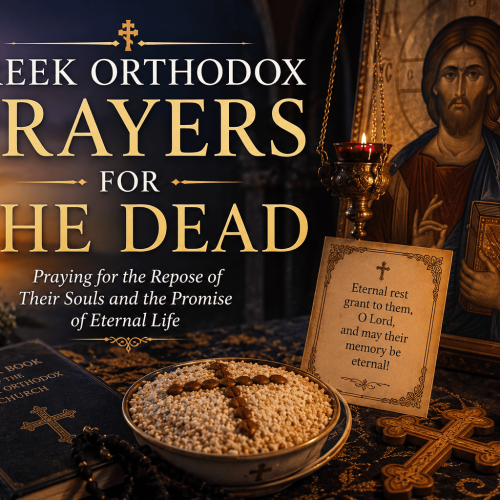
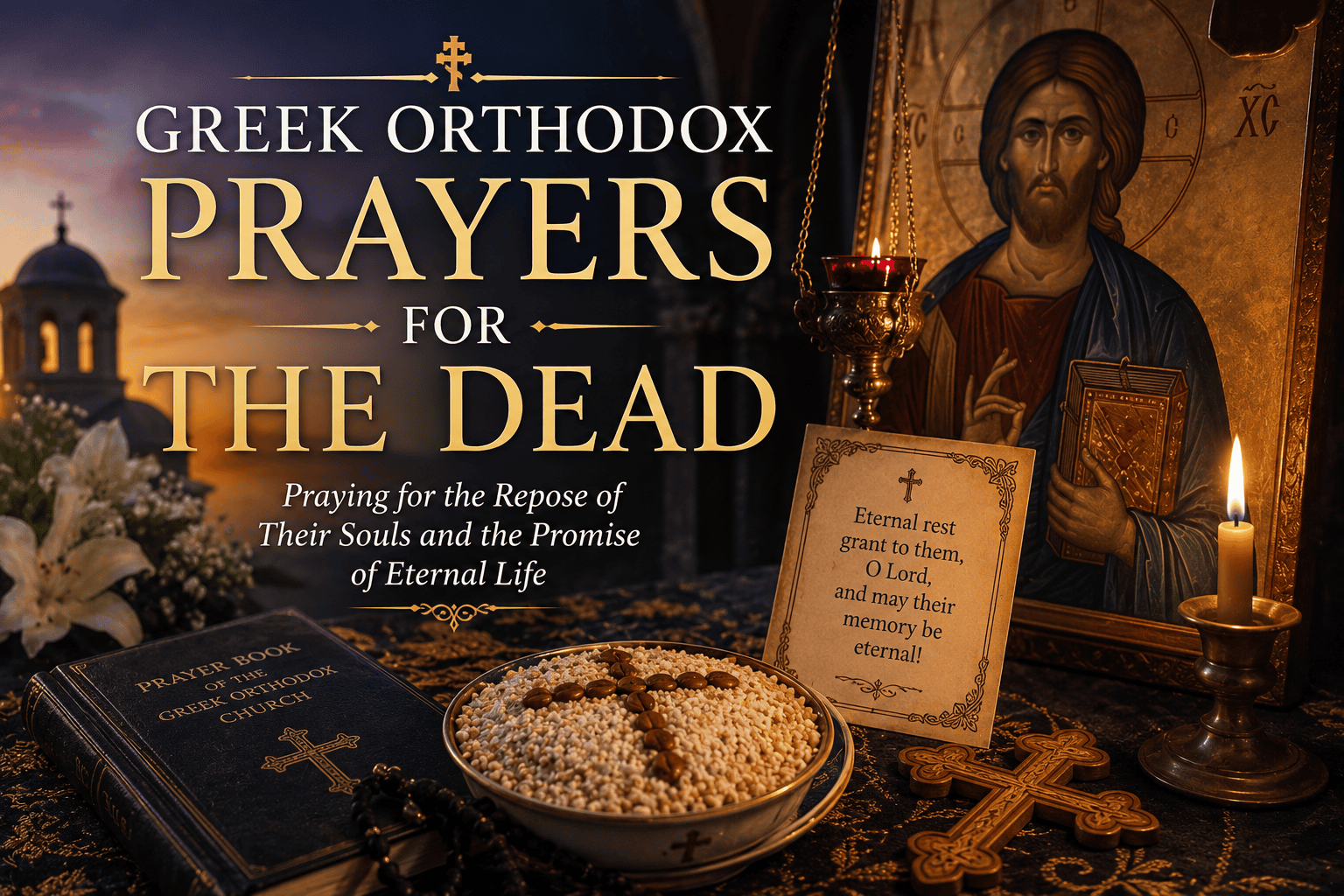
In the Greek Orthodox tradition, prayers for the dead express faith in God’s mercy, the hope of the Resurrection, and continued love for those who have departed this life. The Church remembers the departed during the Divine Liturgy and through special services such as the Trisagion and Memorial Service (Mnemosyna).
For someone grieving a parent, grandparent, spouse, relative, or friend, praying for the departed can also become a meaningful way to place sorrow before God.
This guide explains the traditional Greek Orthodox approach to prayers for the dead and provides original devotional prayers that can be used privately. The original prayers below are not official liturgical texts; they are newly written prayers inspired by themes found in Orthodox worship.
What Are Greek Orthodox Prayers for the Dead?
Greek Orthodox prayers for the dead are prayers asking God to remember the departed, forgive their sins, grant them rest, and receive them among the righteous. Orthodox worship connects these prayers with the Christian hope of the Resurrection.
The practice is not limited to the days immediately following death. The Greek Orthodox Archdiocese of America explains that the Church remembers the departed in the prayers of the Divine Liturgy and also celebrates special memorial services. Traditional memorial observances include the third, ninth, and fortieth days after death and the anniversary of the person’s passing.
These prayers can therefore serve two purposes:
- Prayer for the departed, asking God for mercy and rest.
- Prayer for the living, helping family and friends express grief while holding onto Christian hope.
1. A Traditional Greek Orthodox Prayer for the Departed
The Greek Orthodox tradition includes prayers asking God to remember those who have fallen asleep in faith and to grant them rest with the saints.
The Archdiocese’s daily personal prayers include a specific Commemoration of the Departed, in which Orthodox Christians remember parents, family members, friends, and other faithful departed.
A short traditional phrase associated with Orthodox memorial prayer is:
“May your memory be eternal.”
This expression, commonly sung at the conclusion of memorial services, reflects the importance of remembering the departed before God.
An original prayer inspired by this tradition
Prayer for the Repose of a Loved One
O merciful God, remember Your departed servant, [Name], and receive them in Your compassion. Forgive every sin and weakness, grant them rest among the righteous, and surround them with Your light and peace. Strengthen those who mourn, preserve the love we shared, and keep our hearts rooted in the hope of the Resurrection. Through Your mercy, O Lord, grant eternal rest and blessed memory. Amen.
This is an original devotional prayer, not a quotation from the Greek Orthodox service.
2. The Trisagion Prayer Service
One of the most recognizable Greek Orthodox services for the departed is the Trisagion, meaning “Thrice Holy.”
The Trisagion is a brief memorial service offered for deceased Orthodox Christians. It may take place around the time of death and can also be celebrated at other times after the funeral. The service contains hymns and petitions asking Christ to grant rest to the departed.
The name comes from the opening invocation traditionally associated with the “Thrice-Holy” hymn. The service ultimately focuses on God’s mercy, forgiveness, and the repose of the departed.
The Trisagion may be celebrated:
- Around the time of death
- Before a funeral
- At the graveside
- On certain days following death
- On anniversaries and other memorial occasions
Because the Trisagion is an established Church service, anyone wanting the official liturgical form should obtain it through a Greek Orthodox parish or priest rather than treating an internet-created prayer as the service itself.
3. Greek Orthodox Memorial Service (Mnemosyna)
The Memorial Service, commonly called Mnemosyna, is another important part of Orthodox remembrance.
The Greek Orthodox Archdiocese describes memorial services as prayers for those who have departed in Christ. The Church asks God to forgive their sins and receive them into the company of the saints.
The word Mnemosyna is associated with remembrance or calling to mind. The service gives the community an opportunity to remember a loved one together rather than leaving grief as a private experience.
Memorial services may be observed at particular points after death and annually. The exact scheduling and local customs can vary, so families should consult their parish priest for guidance.
4. A Greek Orthodox Prayer for a Parent Who Has Died
Losing a parent can make prayer especially personal. Orthodox prayers for the departed provide a way to remember a mother or father while entrusting them to God’s mercy.
Original prayer for a departed father
Prayer for My Father
Merciful Lord, I remember before You my beloved father, [Name]. Thank You for the life You gave him and for the love, wisdom, and memories he shared with our family. Forgive his sins and shortcomings, known and unknown, and grant rest to his soul among Your saints. Give him peace in Your presence and strengthen our family as we grieve. Help us honor his memory by living with faith, love, humility, and hope in the Resurrection. Amen.
Original prayer for a departed mother
Prayer for My Mother
O Lord of mercy and life, remember my beloved mother, [Name]. Receive her with compassion and grant rest to her soul. Forgive her sins and surround her with Your peace. Thank You for the love she gave and for the memories that remain with us. When grief feels heavy, strengthen our hearts and help us trust in Your mercy and the hope of eternal life. May her memory remain a blessing to our family. Amen.
These prayers are original devotional compositions rather than quotations from the official Orthodox funeral or memorial services.
5. A Short Orthodox Prayer for the Dead
When grief makes it difficult to find many words, a short prayer can be enough.
Short Prayer for the Departed
Lord Jesus Christ, remember Your departed servant, [Name]. Forgive their sins, grant them rest among the righteous, and receive them in Your mercy. Comfort all who mourn and keep us in the hope of the Resurrection. Amen.
Another simple prayer is:
O Lord, grant rest to the soul of Your departed servant, [Name], forgive their sins, and remember them in Your kingdom. Give comfort and strength to all who mourn. Amen.
For the official wording used in a Greek Orthodox service, consult the parish or priest rather than substituting an unofficial version.
6. What Do Greek Orthodox Christians Pray For?
The prayers and services for the departed consistently emphasize several themes.
| Prayer theme | What it expresses |
|---|---|
| God’s mercy | Trust in God’s compassion toward the departed |
| Forgiveness | A request that God forgive sins |
| Rest | A petition for the soul to rest in God’s presence |
| The Resurrection | Hope centered on Christ’s victory over death |
| The saints | A request that the departed rest among the righteous |
| Remembrance | Continuing to remember a loved one in prayer |
| Comfort | Strength for family members and friends who mourn |
The Greek Orthodox Archdiocese explains that prayers for the departed are connected with the Church’s belief in God’s love, the Resurrection, and the continuing bond of faith and love within the Church.
7. Greek Orthodox Prayers for the Dead at a Funeral
The Orthodox funeral service is more than a farewell. It combines hymns, psalms, Scripture readings, petitions, and prayers for the deceased while also addressing the grief of those who remain.
According to the Greek Orthodox Archdiocese of America, the funeral service includes elements such as:
- The Trisagion
- Verses from Psalm 119
- Funeral hymns
- The Evlogetaria
- The Kontakion
- Scripture readings
- Prayers for the departed
- A final farewell
The service emphasizes Christian hope in eternal life while acknowledging the real pain of separation caused by death.
This distinction matters: a personal prayer written for a website or family gathering should not be presented as a replacement for the Church’s official funeral service.
8. What Is Kollyva and Why Is It Used?
Visitors to a Greek Orthodox memorial service may notice a special dish of kollyva, traditionally made with boiled wheat.
The Greek Orthodox Archdiocese explains that families traditionally bring kollyva to memorial services and that the wheat symbolizes the Resurrection.
The symbolism connects naturally with the Christian image of a grain being placed in the earth and producing new life. In this context, kollyva is not simply food served after a memorial; it has a specific place within Orthodox remembrance.
Customs surrounding preparation and presentation can vary by parish and family, so someone unfamiliar with the practice can ask their priest or parish community for guidance.
9. A Prayer for the Fortieth-Day Memorial
The fortieth day holds an important place in Orthodox remembrance, and memorial prayers may be offered at this time.
Original 40th-day prayer
Loving God, as we remember [Name] on this fortieth-day memorial, receive our prayer with mercy. Grant rest to Your departed servant and forgive every sin. Help us remember that death does not erase the love we shared. Give our family courage to grieve honestly, faith to trust in You, and hope in the Resurrection of Christ. May the memory of [Name] remain precious among us, and may we continue to commend them to Your mercy. Amen.
Again, this is an original prayer intended for personal devotion and is not the official text of the Greek Orthodox Memorial Service.
10. How to Pray for Someone Who Has Died
If you want to pray privately for a departed loved one, you do not need elaborate wording.
A simple approach is:
- Begin by turning your attention to God.
- Name the person you are remembering.
- Thank God for their life and the relationship you shared.
- Ask God to forgive their sins and grant them rest.
- Pray for comfort and strength for those who remain.
- End with hope in Christ and the Resurrection.
For example:
Lord, remember Your servant [Name]. Thank You for the life we shared and for the love that remains in our hearts. Grant rest to their soul, forgive their sins, and receive them according to Your mercy. Strengthen everyone who mourns and keep us faithful to the hope of the Resurrection. Amen.
The goal is not to find a “perfect” sentence. Orthodox prayer for the departed is ultimately an act of entrusting a loved one to God.
11. Can I Pray for the Dead at Home?
Yes. Orthodox Christians can include the departed in their personal prayers. The Greek Orthodox Archdiocese provides personal prayers that specifically include remembrance of parents, relatives, friends, and other departed Orthodox Christians.
Private prayer, however, is distinct from a formal Church service. If your family wants a Trisagion or Memorial Service, contact your local Greek Orthodox parish and ask the priest about the appropriate service and timing.
This distinction is particularly helpful for people searching online because a webpage may provide a devotional prayer, while a priest can provide the official prayers and liturgical guidance of the Church.
12. Finding Comfort While Praying for the Departed
Greek Orthodox prayer does not require a person to hide grief. The funeral tradition recognizes the pain caused by separation and directs that grief toward faith, prayer, and hope. The Greek Orthodox Archdiocese describes the funeral service as an opportunity to acknowledge grief while affirming Christian hope in eternal life.
If you are grieving, it is natural for prayer to change from day to day. Sometimes you may have many words; sometimes a short prayer such as “Lord, remember Your servant” may be all you can say.
You can also remember your loved one through:
- Attending the Divine Liturgy
- Asking your parish about a memorial service
- Speaking with your priest
- Including the departed in personal prayers
- Participating in appropriate memorial traditions
- Sharing memories with family
- Offering practical support to others who are grieving
Prayer does not erase the reality of loss. Instead, for Orthodox Christians, it can provide a way to place that loss within faith in God’s mercy and the Resurrection.
Frequently Asked Questions
What is the main Greek Orthodox prayer for the dead?
There is not just one prayer used in every circumstance. The Greek Orthodox tradition includes the Trisagion Service, Memorial Service, funeral prayers, Divine Liturgy commemorations, and personal prayers for the departed.
What does “May your memory be eternal” mean in Greek Orthodox tradition?
“May your memory be eternal” is a familiar conclusion to Orthodox memorial prayers and services. It expresses the desire that the departed person be remembered and commemorated in faith. The phrase appears at the conclusion of the Trisagion and Memorial Service.
When are memorial prayers offered in the Greek Orthodox Church?
Memorial services are traditionally offered at various times following death, including the third, ninth, and fortieth days and the anniversary. Particular practices can vary, so families should confirm arrangements with their parish priest.
Can I write my own Greek Orthodox prayer for someone who died?
Yes, you can offer personal prayers in your own words. However, an original prayer should not be presented as an official Greek Orthodox liturgical prayer. For formal services, use the prayers provided by the Church and guided by a priest.
What is the difference between a Trisagion and a Memorial Service?
The Trisagion is a brief memorial service that can be celebrated at various times around and after a person’s death. A Memorial Service (Mnemosyna) is another established service for remembering the departed, often celebrated at specific memorial occasions.
A Final Prayer for a Departed Loved One
O Lord our God, source of life and mercy, remember Your departed servant, [Name]. Receive our prayers for them with compassion. Forgive their sins, grant them rest among the righteous, and let the hope of Christ’s Resurrection remain before us. Thank You for the love, memories, and blessings that this person brought into our lives. Comfort those who mourn, strengthen our faith, and teach us to remember our loved ones with prayer and gratitude. For more guidance, see these Greek Orthodox prayers for the departed. May their memory be eternal. Amen..

The Faith & Tradition Research Team helps develop and organize resources relating to religious traditions represented on Prayerium. Our focus is on researching established practices, terminology, historical context, and traditional prayers while presenting different faith traditions with care and respect.