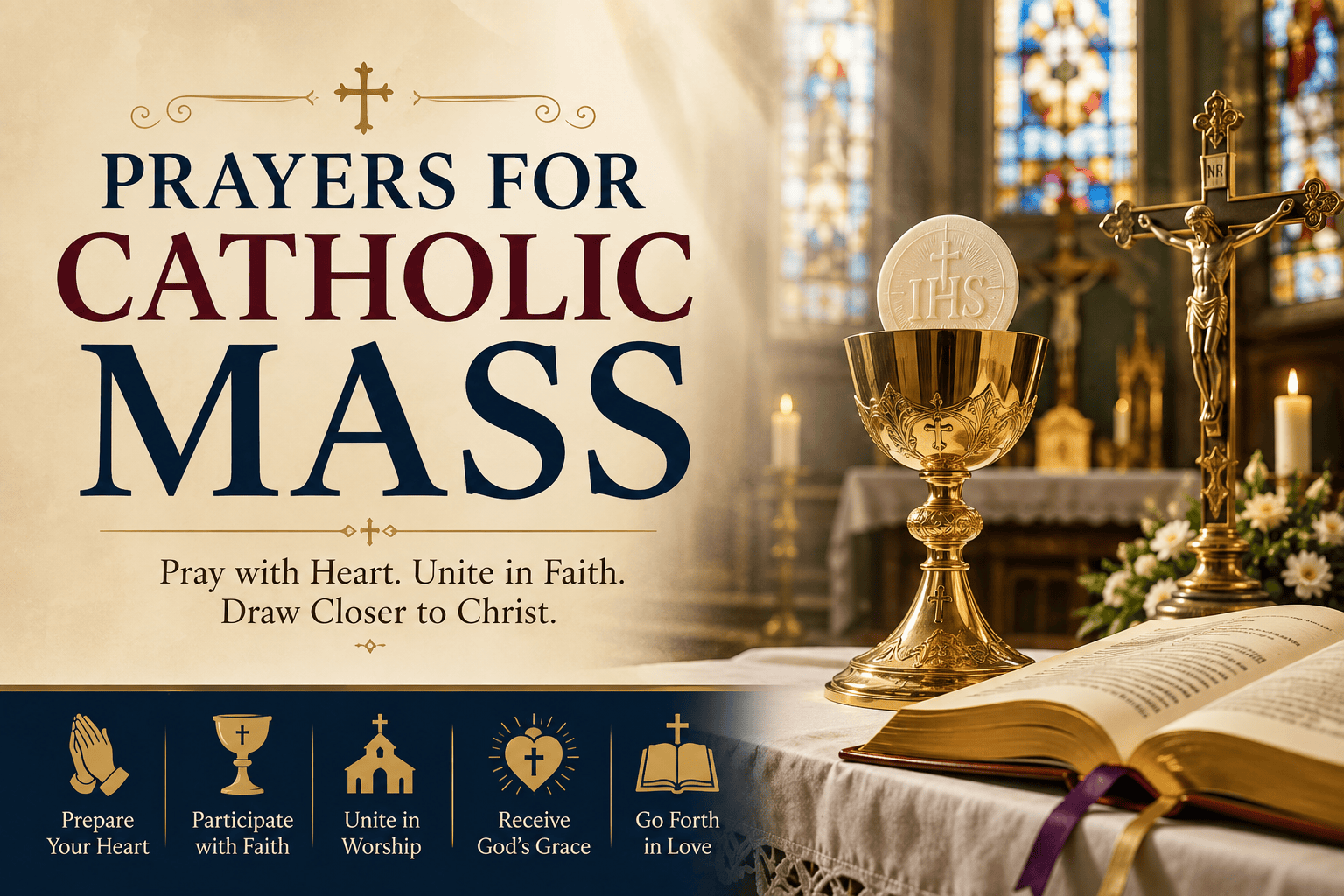
Catholic Mass is a structured act of worship in which the congregation participates through Scripture, prayer, responses, gestures, silence, and the celebration of the Eucharist. If you are looking for prayers for Catholic Mass, it helps to understand not only the prayers themselves but also where they occur and when the congregation participates.
In the Roman Rite used in the United States, the Mass has two closely connected principal parts: the Liturgy of the Word and the Liturgy of the Eucharist, followed by the concluding rites. The United States Conference of Catholic Bishops (USCCB) explains that the faithful participate through acclamations, responses, common prayers, postures, and periods of silence.
What Are the Main Prayers in Catholic Mass?
The prayers and responses Catholics encounter during Mass include:
- The Penitential Act
- The Gloria
- The Collect
- The Responsorial Psalm
- The Profession of Faith (Creed)
- The Universal Prayer or Prayer of the Faithful
- The Prayer over the Offerings
- The Eucharistic Prayer
- The Memorial Acclamation
- The Lord’s Prayer
- The Agnus Dei (Lamb of God)
- The prayer before receiving Holy Communion
- The Prayer after Communion
- The final blessing and dismissal
Not every prayer is spoken by the congregation. Some are led by the priest, while others involve a reader, cantor, deacon, or the entire assembly. The General Instruction of the Roman Missal specifically identifies several prayers and acclamations as parts in which the faithful participate together.
1. The Penitential Act
The Penitential Act occurs near the beginning of Mass. It provides an opportunity for the gathered assembly to acknowledge sin and ask for God’s mercy.
Several approved forms may be used. One familiar form is the Confiteor, which begins with the words:
“I confess to almighty God…”
Other forms use shorter responses invoking God’s mercy.
The Penitential Act is part of the introductory rites and helps prepare the congregation to participate in the celebration.
2. The Gloria
The Gloria, or “Glory to God,” is a hymn of praise used on Sundays outside Advent and Lent and on solemn celebrations according to the liturgical norms.
It praises God the Father and acknowledges Jesus Christ as Lord. The congregation participates together when the Gloria is prescribed.
The General Instruction lists the Gloria among the independent rites or acts that form part of the celebration of Mass.
3. The Collect
The Collect is the opening prayer of the Mass. The priest invites the people to pray and then offers the prayer on behalf of the gathered community.
The congregation concludes by responding Amen.
The General Instruction states that at Mass, a single Collect is said.
Because the Collect changes according to the liturgical day or celebration, there is not one universal Collect used at every Mass.
4. The Responsorial Psalm
The Responsorial Psalm belongs to the Liturgy of the Word and normally follows the first Scripture reading.
The psalm is taken from the Lectionary, and the congregation normally participates by responding to the psalmist or cantor. The USCCB describes the Responsorial Psalm as an integral part of the Liturgy of the Word and emphasizes its role in encouraging meditation on God’s Word.
Because the Psalm changes with the liturgical calendar, the specific prayer or response will be different from one Mass to another.
5. The Profession of Faith
On Sundays and solemnities, Catholics normally profess their faith together through the Creed.
The Roman Missal provides approved forms of the Profession of Faith, including the Nicene Creed and, in appropriate circumstances, the Apostles’ Creed.
The Creed summarizes central Christian beliefs and allows the gathered congregation to respond to the Word of God proclaimed in the readings and explained in the homily.
6. The Prayer of the Faithful
The Universal Prayer, also called the Prayer of the Faithful, comes toward the end of the Liturgy of the Word.
These prayers are offered for the needs of the Church and the wider world. The General Instruction says that the intentions normally include prayers for the Church, public authorities and the salvation of the world, people experiencing difficulties, and the local community.
The congregation responds to each intention according to the form chosen for that celebration.
7. The Prayer over the Offerings
The Prayer over the Offerings occurs during the Liturgy of the Eucharist after the preparation of the gifts.
The priest offers this prayer as the preparation of the gifts is brought to completion. The congregation joins in the prayer and responds Amen.
The wording changes according to the particular Mass being celebrated.
8. The Eucharistic Prayer
The Eucharistic Prayer is the central prayer of the Liturgy of the Eucharist.
During this prayer, the priest addresses God the Father through Jesus Christ in the Holy Spirit. The congregation participates through responses and acclamations.
The General Instruction describes the Eucharistic Prayer as the center and high point of the entire celebration.
Several Eucharistic Prayers are approved for use, so the exact wording heard at Mass can vary.
Important responses during the Eucharistic Prayer
The congregation may participate through several acclamations, including the:
- Holy, Holy, Holy (Sanctus)
- Memorial Acclamation
- Great Amen
These responses allow the entire assembly to participate rather than simply listen to the priest’s prayer.
9. The Lord’s Prayer
The Lord’s Prayer, commonly known as the Our Father, is prayed during the Communion Rite.
It is one of the best-known Christian prayers and is shared by Christians across different traditions.
Within Catholic Mass, it forms part of the Communion Rite before the rite of peace and the breaking of the bread.
10. The Agnus Dei: Lamb of God
The Agnus Dei, or Lamb of God, is an acclamation used during the rite of the breaking of the bread.
It asks for mercy and peace and prepares the congregation for Holy Communion.
The General Instruction identifies the Agnus Dei as an acclamation accompanying the fraction rite.
11. Prayer Before Holy Communion
Before receiving Holy Communion, the congregation makes a response expressing faith in Christ and humility.
The exact wording is part of the approved liturgical text, so it should not be confused with a personal devotional prayer that someone might compose independently.
Catholic teaching treats the reception of Holy Communion as an important part of participation in the Eucharistic celebration. In the United States, the USCCB explains that the communicant responds Amen when the minister says, “The Body of Christ.”
12. The Prayer After Communion
After the Communion Rite, the priest says the Prayer after Communion.
This prayer asks for the fruits of the mystery celebrated during Mass. The congregation makes the prayer its own by responding Amen.
Like the Collect and Prayer over the Offerings, this prayer varies according to the particular celebration.
13. The Final Blessing and Dismissal
The Mass concludes with the Concluding Rites.
These may include:
- Announcements when necessary
- The priest’s greeting and blessing
- A dismissal by the priest or deacon
- The concluding actions prescribed by the liturgy
The dismissal sends the faithful forth from the celebration rather than simply marking the end of a meeting. The General Instruction includes the blessing and dismissal among the concluding rites of Mass.
Catholic Mass Prayers in Order
For someone learning the order of Mass, this simplified sequence can be useful:
| Part of Mass | Prayer or response |
|---|---|
| Introductory Rites | Penitential Act |
| Introductory Rites | Gloria, when prescribed |
| Introductory Rites | Collect |
| Liturgy of the Word | Responsorial Psalm |
| Liturgy of the Word | Gospel acclamation |
| Liturgy of the Word | Creed, when prescribed |
| Liturgy of the Word | Prayer of the Faithful |
| Liturgy of the Eucharist | Prayer over the Offerings |
| Liturgy of the Eucharist | Eucharistic Prayer |
| Communion Rite | Lord’s Prayer |
| Communion Rite | Agnus Dei |
| Communion Rite | Prayer before Communion |
| Communion Rite | Communion responses |
| Concluding Rites | Prayer after Communion |
| Concluding Rites | Blessing and dismissal |
The exact prayers used can vary according to the day, season, feast, and approved form of the Mass.
What Should You Say During Catholic Mass?
If you are attending Mass for the first time or returning after a long absence, you do not need to memorize everything immediately.
A helpful approach is to follow the congregation and use the approved Roman Missal or a parish worship aid. The Mass includes spoken responses, sung responses, prayers, gestures, postures, and periods of silence.
If you are unsure about a response, it is perfectly reasonable to listen and follow along with the people around you.
Are Catholic Mass Prayers the Same Every Sunday?
No. Some parts remain consistent while others change.
The structure of Mass is stable, but specific prayers, Scripture readings, Responsorial Psalms, Collects, and other texts can change according to the liturgical calendar and celebration.
This is why the prayer booklet or worship aid provided for a particular Mass can be useful.
Can You Use Personal Prayers During Mass?
Personal prayer can be appropriate during moments of silence or other suitable times, but the Mass itself has an established liturgical structure.
Catholic worship emphasizes participation in the prayers and responses of the whole assembly. The USCCB explains that participation includes listening to Scripture, responding to prayers and acclamations, using common postures and gestures, and observing communal silence.
A personal devotional prayer should therefore not be presented as though it were an official text of the Mass.
What Is the Difference Between Mass Prayers and Personal Catholic Prayers?
Mass prayers are part of the Church’s public liturgy and follow approved liturgical texts and forms.
Personal Catholic prayers are devotional prayers that individuals may use privately or in other appropriate settings.
For example, a person might privately pray for wisdom, gratitude, forgiveness, or the needs of family members. Those personal prayers are different from the official prayers and responses used during Mass.
Keeping this distinction clear helps readers understand which words belong to the liturgy and which are personal devotion.
Frequently Asked Questions
What are the main prayers said during Catholic Mass?
Important prayers and responses include the Penitential Act, Gloria, Collect, Responsorial Psalm, Creed, Prayer of the Faithful, Prayer over the Offerings, Eucharistic Prayer, Lord’s Prayer, Agnus Dei, Communion responses, and Prayer after Communion.
What prayer is said before Communion?
The congregation participates in the approved prayer and response before receiving Holy Communion. At the reception of Communion, the minister says “The Body of Christ,” and the communicant responds “Amen.”
Is the Lord’s Prayer part of Catholic Mass?
Yes. The Lord’s Prayer is part of the Communion Rite of the Mass.
Does the Catholic Mass use Scripture?
Yes. Scripture readings are a central part of the Liturgy of the Word, which also includes the Responsorial Psalm, Gospel acclamation, homily, Profession of Faith when prescribed, and Prayer of the Faithful.
Do Catholic Mass prayers change?
Some prayers and responses remain part of the regular structure, while other texts change according to the liturgical day, season, feast, or particular celebration.
Final Thoughts
The prayers for Catholic Mass are not simply a collection of individual prayers. Together, they form a structured act of worship in which the congregation listens, responds, prays, sings, observes silence, and participates in the Eucharistic celebration.
If you are learning the Mass, start by becoming familiar with its basic flow: Introductory Rites → Liturgy of the Word → Liturgy of the Eucharist → Communion Rite → Concluding Rites.

The Catholic Prayer Editor focuses on prayer resources connected with Catholic devotional life and tradition, including prayers to saints, the Rosary, Mary, Catholic Scripture reflections, Mass-related prayers, and prayers for important moments in life. Content is prepared with an emphasis on respectful and accurate representation of Catholic traditions.