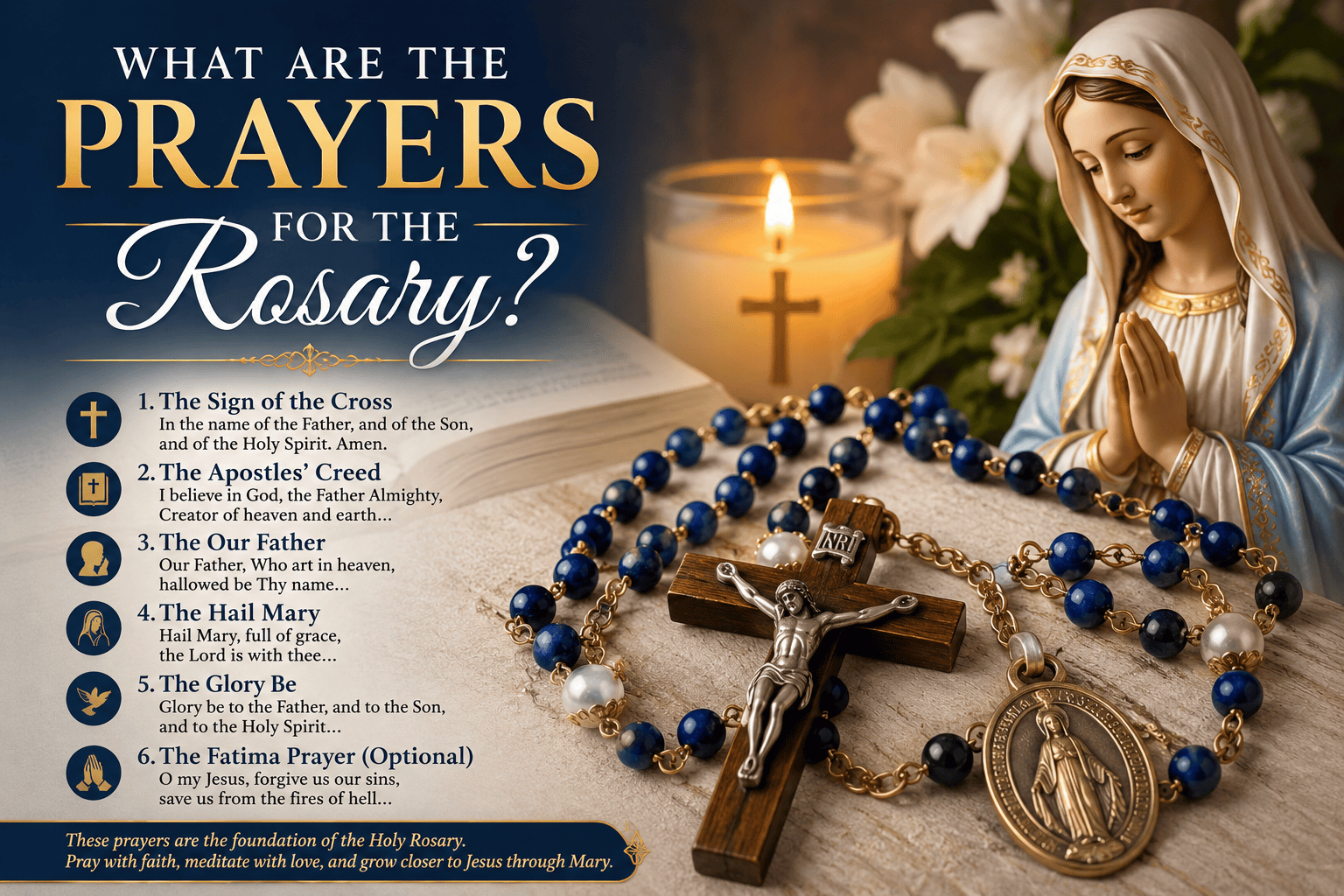
If you are wondering what are the prayers for the Rosary, the Rosary is a Catholic devotional prayer centered on meditation on important events in the life of Jesus Christ. It uses several familiar prayers in a repeated structure.
The main prayers include the Apostles’ Creed, Our Father, Hail Mary, Glory Be, and Hail Holy Queen. In addition, some Catholics pray the Fatima Prayer after each decade. The Rosary also includes the Sign of the Cross at the beginning and end. The exact practice can vary slightly by tradition or personal devotion.
The most important point is that the Rosary is not simply a series of repeated words. Instead, Catholics pray these prayers while reflecting on the Mysteries of the Rosary, which focus on events in Christ’s life.
What Prayers Are Said in the Rosary?
Here is a quick overview of the principal prayers and where they occur:
| Prayer | Where it is prayed | Purpose |
|---|---|---|
| Sign of the Cross | Beginning and end | Opens and concludes the Rosary |
| Apostles’ Creed | At the crucifix | Profession of Christian faith |
| Our Father | Before each decade | Introduces each Mystery |
| Hail Mary | Ten times in each decade | Repeated prayer while meditating on a Mystery |
| Glory Be | After each decade | Doxology giving glory to the Trinity |
| Fatima Prayer | Often after each decade | Optional devotional prayer |
| Hail Holy Queen | After five decades | Concluding Marian prayer |
The United States Conference of Catholic Bishops describes the Rosary as a Scripture-based prayer and explains this basic sequence in its guide to praying the Rosary.
1. The Sign of the Cross
The Rosary traditionally begins with the Sign of the Cross.
This short Christian prayer invokes the Father, Son, and Holy Spirit. It marks the beginning of the devotion and is repeated at the end when the Rosary is concluded.
For many Catholics, beginning this way provides a simple transition from ordinary activities into intentional prayer and meditation.
2. The Apostles’ Creed
After making the Sign of the Cross, the person praying the Rosary traditionally recites the Apostles’ Creed while holding the crucifix.
The Creed summarizes central Christian beliefs concerning:
- God the Father
- Jesus Christ
- The Holy Spirit
- The Church
- The forgiveness of sins
- The resurrection
- Eternal life
Therefore, the Creed establishes the faith framework for the rest of the Rosary. It is not a prayer created specifically for the Rosary; rather, it is a historic Christian statement of faith used within the devotion.
The USCCB includes the Apostles’ Creed as the opening prayer of its Rosary sequence.
3. The Our Father
Next comes the Our Father, also known as the Lord’s Prayer.
This prayer comes from the Gospels and is traditionally prayed on the larger beads. Before each decade, the person praying announces or considers one of the Mysteries and then says the Our Father.
The prayer focuses on God’s name, God’s kingdom and will, daily needs, forgiveness, and protection from evil.
Because the Our Father comes directly from Jesus’ teaching in the Gospels, it occupies an important place in Catholic prayer generally and in the Rosary specifically.
4. The Hail Mary
The Hail Mary is the prayer repeated most frequently during the Rosary.
A typical Rosary contains five decades, and each decade has 10 Hail Marys. Consequently, 50 Hail Marys are normally prayed during the five decades.
The prayer has two major biblical foundations. Its opening words draw from the angel Gabriel’s greeting to Mary and Elizabeth’s greeting to Mary in the Gospel of Luke. The second portion asks Mary to pray for those who are praying.
During the Hail Marys, Catholics meditate on the particular Mystery being prayed. Thus, the repetition is intended to accompany contemplation rather than function as a disconnected recitation.
5. The Glory Be
After the ten Hail Marys of each decade, Catholics traditionally pray the Glory Be, also called the Doxology.
This brief prayer gives glory to:
- The Father
- The Son
- The Holy Spirit
The prayer concludes each decade by directing attention toward the Trinity. The USCCB lists the Glory Be as part of the standard sequence for each decade.
6. The Fatima Prayer
The Fatima Prayer is commonly added after each decade by many Catholics. However, it is important to distinguish it from the core prayers of the Rosary.
The USCCB describes it as a prayer that some Catholics say after each decade. Therefore, it is better understood as a customary devotional addition rather than an essential part of the basic Rosary sequence.
This distinction is useful for beginners because different Rosary guides may include slightly different optional prayers.
7. The Hail Holy Queen
After completing the five decades, the Rosary traditionally concludes with the Hail Holy Queen, also known by its Latin name, Salve Regina.
This prayer addresses Mary as the mother of mercy and asks for her prayers. It concludes by directing attention toward Jesus.
The Vatican’s presentation of the Rosary includes the Hail Holy Queen among the concluding Marian prayers, while the USCCB likewise includes it after the five decades.
How Do These Prayers Fit Together?
Knowing the individual prayers is helpful. However, beginners often find the order more confusing than the prayers themselves.
Here is a simple overview:
- Make the Sign of the Cross.
- Pray the Apostles’ Creed on the crucifix.
- Pray the Our Father on the first large bead.
- Pray three Hail Marys on the next three beads.
- Pray the Glory Be.
- Announce the first Mystery.
- Pray the Our Father.
- Pray ten Hail Marys while meditating on the Mystery.
- Pray the Glory Be.
- Optionally pray the Fatima Prayer.
- Repeat the same pattern for the remaining four decades.
- Pray the Hail Holy Queen after the five decades.
- Conclude with the Sign of the Cross.
This basic structure is consistent with the Rosary instructions provided by the USCCB.
What Are the Mysteries of the Rosary?
The prayers are accompanied by meditation on four groups of Mysteries. Each group contains five events connected with the life of Christ.
| Mysteries | Main focus |
|---|---|
| Joyful Mysteries | Events surrounding Jesus’ birth and early life |
| Sorrowful Mysteries | Christ’s Passion and suffering |
| Glorious Mysteries | Resurrection and other events connected with Christ’s glory |
| Luminous Mysteries | Important events in Christ’s public ministry |
The four sets are the Joyful, Sorrowful, Glorious, and Luminous Mysteries. The Luminous Mysteries were introduced by Pope John Paul II in 2002.
For example, the Joyful Mysteries include the Annunciation, Visitation, Nativity, Presentation, and Finding of Jesus in the Temple. Meanwhile, the Sorrowful Mysteries focus on events such as Jesus’ Agony in the Garden, Scourging, Crowning with Thorns, Carrying of the Cross, and Crucifixion.
The Mysteries give the repeated prayers a specific subject for meditation.
Why Does the Rosary Repeat the Hail Mary?
For someone unfamiliar with the Rosary, repeating the same prayer many times can seem unusual.
However, repetition is part of the devotional structure. The purpose is to provide a steady prayer while the person reflects on a Mystery. The USCCB explains that the repetition is intended to support restful, contemplative prayer related to the Mysteries.
In other words, the words and meditation work together.
Rather than trying to rush through 10 Hail Marys, a person can use each prayer as an opportunity to remain focused on the particular event being contemplated.
How Many Hail Marys Are in a Rosary?
A traditional five-decade Rosary includes 50 Hail Marys during the five decades.
Each decade contains:
- 1 Our Father
- 10 Hail Marys
- 1 Glory Be
- Optional Fatima Prayer
There are also three Hail Marys near the beginning of the traditional sequence, before the five decades begin.
Therefore, the total number of Hail Marys in the complete traditional sequence is 53.
The number 50 refers specifically to the five groups of 10 Hail Marys.
Do You Have to Know Every Prayer Before Starting?
No. A beginner does not need to memorize everything before praying the Rosary.
Instead, you can begin by learning the basic order and becoming familiar with the principal prayers one at a time.
A simple approach is:
First, learn the Our Father and Hail Mary.
Next, learn the Glory Be and Apostles’ Creed.
Then, become familiar with the Mysteries.
Finally, add optional prayers such as the Fatima Prayer if you wish.
This approach can make the Rosary feel much less complicated.
Is the Rosary Only About Mary?
The Rosary has a strong Marian character because the Hail Mary is repeated throughout the devotion. Nevertheless, its Mysteries focus on Christ and events in his life.
The USCCB specifically describes the Rosary as a Scripture-based prayer whose Mysteries center on events from Christ’s life.
Consequently, understanding the Rosary requires looking at both elements: the Marian prayers and the Christ-centered Mysteries.
A Simple Way to Pray the Rosary as a Beginner
If you are learning the Rosary for the first time, keep the process straightforward.
Step 1: Begin with the Sign of the Cross
Take a moment to become quiet and attentive.
Step 2: Pray the opening prayers
Use the crucifix and beads to follow the Apostles’ Creed, Our Father, three Hail Marys, and Glory Be.
Step 3: Choose the appropriate Mysteries
Select the Mysteries traditionally associated with the day or choose a set you would like to meditate on.
Step 4: Announce the first Mystery
Briefly identify the Mystery before beginning the decade.
Step 5: Pray the decade slowly
Pray the Our Father, followed by 10 Hail Marys and the Glory Be. During the prayers, keep your attention on the Mystery.
Step 6: Continue through all five decades
Repeat the same pattern with the remaining Mysteries.
Step 7: Finish with the concluding prayer
After the fifth decade, pray the Hail Holy Queen and conclude according to your customary Rosary practice.
The Vatican likewise describes the basic decade pattern as announcing the Mystery, praying the Our Father, praying ten Hail Marys while contemplating the Mystery, and then praying the Glory Be.
Frequently Asked Questions
What are the main prayers of the Rosary?
The main prayers are the Apostles’ Creed, Our Father, Hail Mary, Glory Be, and Hail Holy Queen. The Sign of the Cross begins and ends the devotion. Some Catholics also include the Fatima Prayer after each decade.
How many prayers are in one decade of the Rosary?
One decade consists of one Our Father, ten Hail Marys, and one Glory Be. Some Catholics also add the Fatima Prayer.
What do you meditate on while praying the Rosary?
You meditate on one of the Rosary’s Mysteries, which concern significant events in the life of Jesus and, within the traditional structure, events involving Mary.
Can I pray the Rosary without a physical Rosary?
Yes. The beads are useful for keeping your place, but the essential devotion is the prayer and meditation. You can also use your fingers or another simple method to keep track of the decades.
Is the Fatima Prayer required?
No. It is a common devotional addition, but the USCCB identifies it as something that some Catholics say after each decade.
Final Thoughts
If you are asking what are the prayers for the Rosary, start by remembering the five principal prayers: Apostles’ Creed, Our Father, Hail Mary, Glory Be, and Hail Holy Queen.
From there, learn the structure of the five decades and become familiar with the four sets of Mysteries. Most importantly, remember that the Rosary combines spoken prayer with meditation on Christ’s life.
The Prayerium Editorial Team creates and reviews thoughtful prayer resources for life’s meaningful moments. Our work covers daily prayers, healing and comfort, protection, family and relationships, gratitude, grief, life challenges, and special occasions. We use research, editorial review, and technology-assisted writing workflows to create clear, respectful, and useful resources for our readers.