
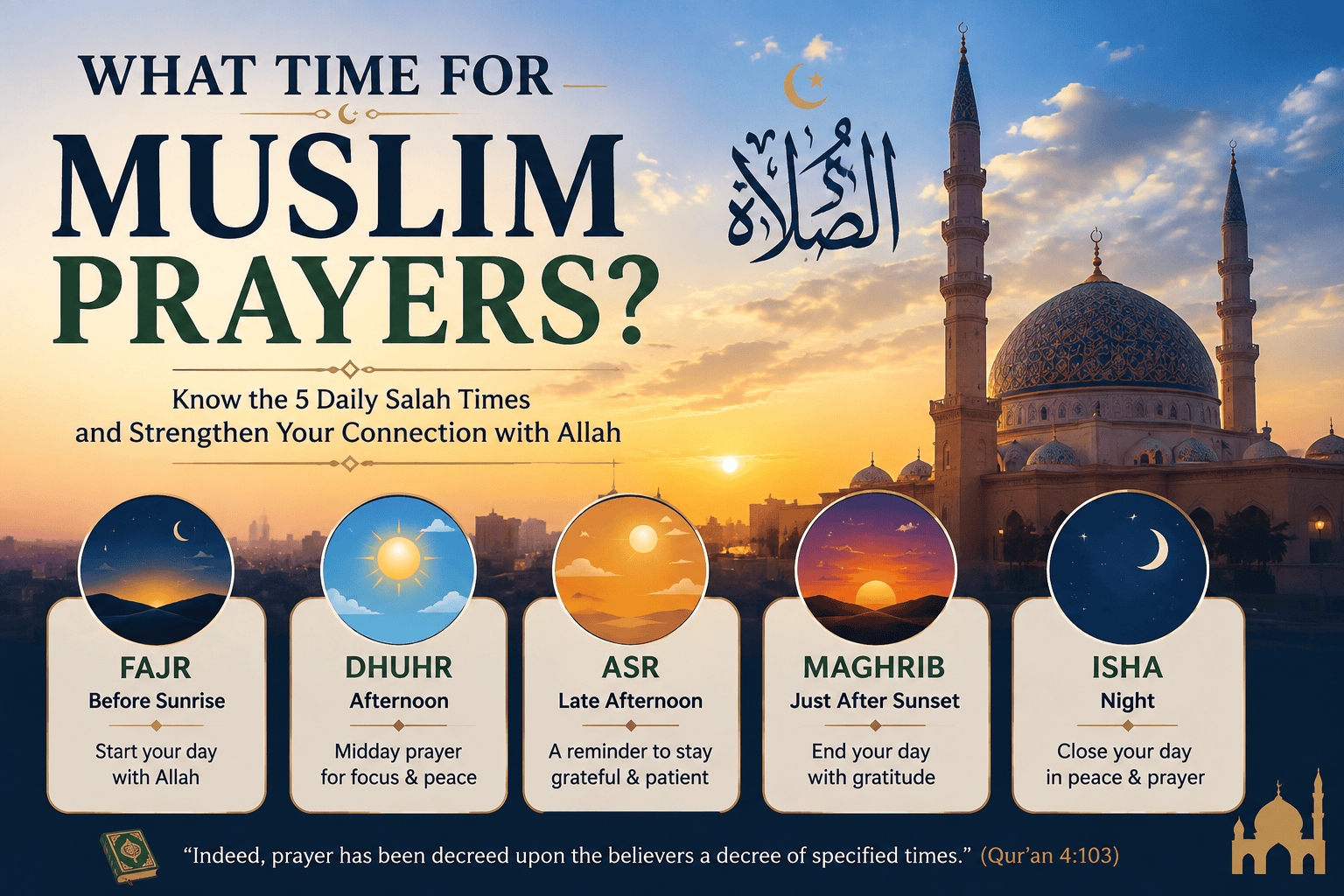
Muslims pray five obligatory daily prayers, known as Salah or Salat: Fajr, Dhuhr, Asr, Maghrib, and Isha. Unlike a fixed clock schedule, their times are determined primarily by the position of the sun, so the exact prayer time changes according to the date and location.
For Muslims in the United States, there is no single prayer schedule that applies to everyone. A person in New York, Chicago, Houston, or Los Angeles will have different prayer times on the same day. Prayer times also change throughout the year as sunrise, midday, sunset, and twilight change.
The Qur’an describes prayer as a duty prescribed at appointed times, emphasizing that Salah is connected to specific times rather than one universal clock hour.
The five Muslim prayer times at a glance
| Prayer | General time | Main solar marker |
|---|---|---|
| Fajr | Before sunrise | Dawn |
| Dhuhr | Around midday | After the sun passes its highest point |
| Asr | Afternoon | Based on the length of an object’s shadow |
| Maghrib | Immediately after sunset | Sunset |
| Isha | Evening/night | Disappearance of twilight |
These descriptions explain the general prayer windows. The exact beginning and ending times can vary depending on location, date, calculation settings, and—in some cases—juristic school.
1. Fajr Prayer Time
Fajr is the first of the five daily prayers. Its time begins at dawn, specifically with the appearance of the true dawn, and continues until sunrise.
For this reason, a Fajr timetable may look very different in different parts of the United States. During summer, Fajr can begin particularly early in many northern locations, while the timing changes considerably during winter.
When checking a prayer schedule, look for:
- Fajr — the beginning of the Fajr prayer window
- Sunrise — the approximate end of the Fajr prayer time
The sunrise time should not be confused with Fajr. Fajr begins earlier, during the pre-sunrise period.
2. Dhuhr Prayer Time
Dhuhr, also called Zuhr, is the midday prayer. Its time begins after the sun has passed its highest point in the sky and begins moving westward.
Dhuhr therefore does not simply mean “12:00 PM.” On some days it may begin shortly after noon, while the exact time depends on your location and the date.
For example, someone in the eastern United States and someone on the West Coast will have different Dhuhr times because solar noon occurs at different clock times.
The important distinction is:
Dhuhr is based on the sun’s position, not a fixed clock hour.
3. Asr Prayer Time
Asr is the afternoon prayer. Its beginning is calculated using the position of the sun and the length of an object’s shadow.
This is one of the prayer times where calculation settings can produce different results.
The Hanafi school traditionally has a later beginning for Asr based on a longer shadow, while the other three Sunni schools generally use a shorter shadow measurement. There are also established positions within Hanafi scholarship concerning the calculation of Asr.
This is why two reputable prayer calendars may show different Asr times even when they use the same location and date.
If your local mosque follows a particular calculation, it is generally practical to use the schedule followed by that mosque rather than switching between different settings without understanding the difference.
4. Maghrib Prayer Time
Maghrib begins after sunset.
This makes Maghrib one of the easiest prayer times to understand: once the sun has set according to the relevant local calculation, the Maghrib prayer window begins.
However, Maghrib is not simply the same as the sunset time displayed in every weather app or calendar. Prayer calendars may apply specific astronomical calculations and conventions, so a small difference between two schedules can occur.
Because Maghrib begins around sunset, its time also changes noticeably throughout the year.
5. Isha Prayer Time
Isha is the night prayer. Its beginning is connected with the disappearance of evening twilight after sunset.
The exact calculation of Isha can vary because prayer calendars use different astronomical methods for determining twilight. Some calculation systems use specific solar depression angles for Fajr and Isha. For example, IslamicFinder lists several calculation methods, including the Islamic Society of North America (ISNA) method for parts of the United States, Canada, and the United Kingdom.
Some juristic discussions also address differences concerning the details of when Isha begins and ends.
For everyday use, the most important point is to know which calculation method your local mosque or trusted prayer timetable follows.
Why Do Muslim Prayer Times Change Every Day?
Muslim prayer times change because they are connected to the sun’s position.
Several factors affect the displayed times:
Location
Latitude and longitude affect sunrise, sunset, solar noon, and twilight. A prayer time in New York will not necessarily match one in Dallas or Los Angeles.
Date and season
The length of daylight changes throughout the year. As sunrise and sunset move, the corresponding prayer times move as well.
Calculation method
Different organizations and prayer applications can use different astronomical parameters. This is particularly noticeable with Fajr and Isha.
Asr calculation
Different schools of Islamic jurisprudence may use different criteria for the beginning of Asr. This can create a noticeable difference between prayer schedules.
What Are the Muslim Prayer Times in the United States?
There is no single set of Muslim prayer times for the entire United States.
To find today’s times, you need to enter your city or ZIP code into a reliable prayer-time service or check the timetable provided by your local mosque.
For example, a Muslim living in:
- New York City will have one set of prayer times.
- Chicago will have another.
- Houston will have another.
- Los Angeles will have another.
- Seattle will have another.
Even within the same state, prayer times can differ slightly between cities.
For this reason, an article cannot responsibly give one set of clock times and label them as the prayer times for all American Muslims.
What Should I Use to Check Today’s Prayer Times?
When looking for today’s Salah schedule, choose a timetable that allows you to set your location, date, and calculation method.
A useful prayer timetable should show at least:
- Fajr
- Sunrise
- Dhuhr
- Asr
- Maghrib
- Isha
Many prayer-time services also allow users to select a calculation method. IslamicFinder, for example, lists multiple calculation organizations and explains that different methods use different solar angles for Fajr and Isha.
If your local mosque publishes a daily or monthly timetable, comparing your app with that local schedule can help you understand why times may differ.
Why Do Prayer Apps Sometimes Show Different Times?
Seeing two different prayer times on two apps does not automatically mean that one is wrong.
Differences can result from:
- Different calculation methods
- Different Asr settings
- Different geographic coordinates
- Different daylight-saving-time settings
- Different methods for calculating high-latitude prayer times
- Different local mosque preferences
For example, IslamicFinder’s published calculation information shows that organizations can use different solar depression angles for Fajr and Isha.
If the difference is significant, check the settings rather than immediately assuming there is an error.
Does Every Muslim Follow the Same Prayer Time?
The five obligatory prayers are the same, but some details used to calculate their time windows can differ among Islamic schools and prayer-time organizations.
The most commonly noticeable difference is Asr. The Hanafi tradition has a recognized later calculation, while other Sunni schools generally use the earlier shadow criterion.
There can also be differences in the astronomical calculations used for Fajr and Isha.
This does not mean Muslims have different numbers of daily prayers. The five obligatory prayers remain:
Fajr → Dhuhr → Asr → Maghrib → Isha
The differences concern how the boundaries of certain prayer times are calculated.
A Simple Way to Remember the Five Prayer Times
If you are new to Salah, remember the prayers by their relationship to the day:
Fajr — dawn
Dhuhr — after midday
Asr — afternoon
Maghrib — sunset
Isha — night
This simple sequence makes it easier to understand why prayer times move throughout the year.
Common Mistakes When Checking Muslim Prayer Times
Mistake 1: Assuming prayer time is the same every day
Prayer times change with the sun. A schedule from last month should not automatically be used for today.
Mistake 2: Using another city’s timetable
Even nearby cities can have different prayer times. Always select your actual location when possible.
Mistake 3: Confusing Fajr with sunrise
Fajr begins before sunrise. Sunrise marks an important boundary for the Fajr prayer window.
Mistake 4: Ignoring the Asr calculation setting
If two calendars show different Asr times, check whether they are using the same school or shadow calculation.
Mistake 5: Assuming every app uses the same calculation method
Prayer applications can use different astronomical parameters. Check the settings if the times do not match your local mosque.
What Time Should Muslims Pray Today?
The answer depends on where you live and today’s date.
For a Muslim in the United States, the most reliable approach is to select your city in a trusted prayer timetable and verify the calculation method used. If your local mosque provides a schedule, it can also be a useful reference for the times followed by your community.
Prayer times are not arbitrary clock appointments. They are tied to observable changes in the day and night, which is why the schedule naturally changes as the year progresses.
The Qur’an describes Salah as a duty established at appointed times, making awareness of the prayer windows an important part of observing the daily prayers.
Frequently Asked Questions
What are the five Muslim prayer times?
The five obligatory daily prayers are Fajr, Dhuhr, Asr, Maghrib, and Isha.
What time is Fajr?
Fajr begins at true dawn and ends at sunrise. The exact clock time depends on your location and the date.
What time is Dhuhr?
Dhuhr begins after the sun passes its highest point for the day. Its exact clock time varies by location and date.
What time is Asr?
Asr is the afternoon prayer. Its beginning is calculated using the sun’s position and an object’s shadow. The exact time can differ according to the Islamic school or calculation method being followed.
What time is Maghrib?
Maghrib begins after sunset. The exact clock time changes throughout the year and differs by location.
What time is Isha?
Isha begins after evening twilight has disappeared according to the calculation method being used. Its exact time therefore varies by location, date, and calculation settings.
Why are Muslim prayer times different from one city to another?
Prayer times are based on the sun’s position. Because sunrise, sunset, solar noon, and twilight vary geographically, Muslims in different cities have different Salah times.
Final Takeaway
If you are asking “What time are Muslim prayers?“, there is no single clock schedule for every Muslim.
The five daily prayers are:
- Fajr — dawn
- Dhuhr — after midday
- Asr — afternoon
- Maghrib — after sunset
- Isha — night
For the correct times, use your local city, current date, and an appropriate calculation method. If your mosque publishes a timetable, checking it can also help you follow the schedule used by your local Muslim community.

The Catholic Prayer Editor focuses on prayer resources connected with Catholic devotional life and tradition, including prayers to saints, the Rosary, Mary, Catholic Scripture reflections, Mass-related prayers, and prayers for important moments in life. Content is prepared with an emphasis on respectful and accurate representation of Catholic traditions.