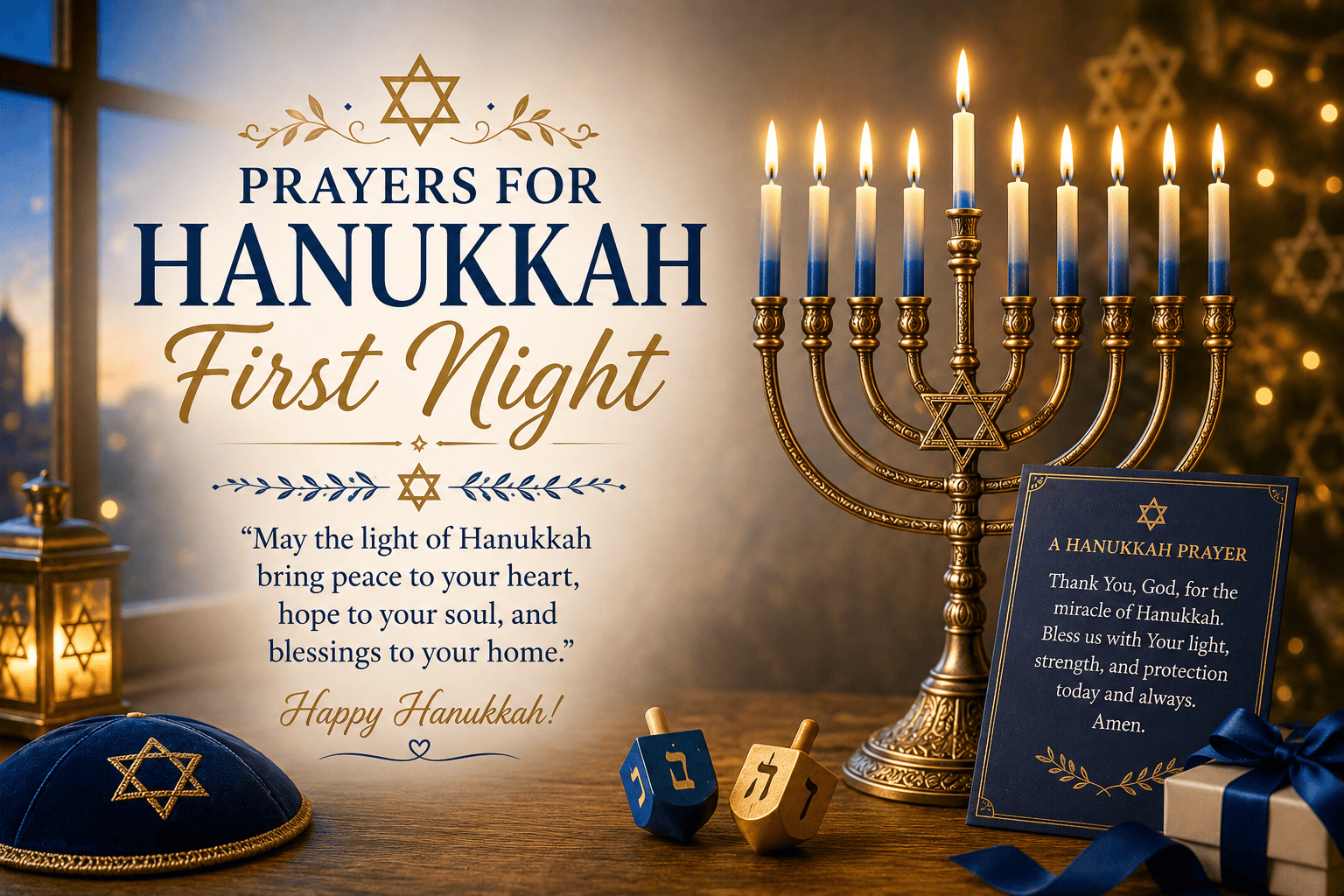
The first night of Hanukkah begins an eight-night Jewish festival centered on the lighting of the hanukkiyah, commonly called a Hanukkah menorah. For many Jewish families, the first evening is especially meaningful because it includes the lighting of the first candle and the recitation of three traditional blessings.
If you are looking for prayers for Hanukkah first night, this guide explains the traditional blessings, their meaning, when they are recited, and how the first-night candle-lighting ceremony generally works.
What Prayers Are Said on the First Night of Hanukkah?
On the first night of Hanukkah, three traditional blessings are recited before the Hanukkah lights are kindled:
- The blessing for lighting the Hanukkah lamp.
- The blessing remembering the miracles associated with Hanukkah.
- The Shehecheyanu, a blessing expressing gratitude for reaching this special occasion.
On the following nights, the first two blessings are traditionally recited, while Shehecheyanu is generally reserved for the first lighting of the season.
These are traditional Jewish blessings rather than newly written prayers. Because customs can vary among Jewish communities and movements, families may follow the practices of their synagogue, rabbi, or tradition.
First Hanukkah Blessing: Lighting the Candle
The first blessing is traditionally recited before lighting the Hanukkah candles.
Hebrew:
בָּרוּךְ אַתָּה יְיָ אֱלֹהֵינוּ מֶלֶךְ הָעוֹלָם, אֲשֶׁר קִדְּשָׁנוּ בְּמִצְוֹתָיו וְצִוָּנוּ לְהַדְלִיק נֵר שֶׁל חֲנֻכָּה.
Transliteration:
Baruch atah, Adonai Eloheinu, Melech haolam, asher kid’shanu b’mitzvotav v’tsivanu l’hadlik ner shel Hanukkah.
Meaning:
This blessing praises God and acknowledges the commandment associated with lighting the Hanukkah lamp. The wording is traditionally recited as part of the candle-lighting ceremony.
Second Hanukkah Blessing: Remembering the Miracles
The second blessing focuses on remembering the miracles associated with the Hanukkah story.
Hebrew:
בָּרוּךְ אַתָּה יְיָ אֱלֹהֵינוּ מֶלֶךְ הָעוֹלָם, שֶׁעָשָׂה נִסִּים לַאֲבוֹתֵינוּ בַּיָּמִים הָהֵם בַּזְּמַן הַזֶּה.
Transliteration:
Baruch atah, Adonai Eloheinu, Melech haolam, she’asah nisim la’avoteinu bayamim hahem bazman hazeh.
Meaning:
The blessing gives thanks for the miracles remembered during Hanukkah and connects those events with the celebration taking place in the present. This blessing is recited on each night of Hanukkah.
Third Blessing: Shehecheyanu
The third blessing is Shehecheyanu, which is especially associated with reaching a new or significant occasion.
Transliteration:
Baruch atah, Adonai Eloheinu, Melech haolam, shehecheyanu v’kiy’manu v’higiyanu lazman hazeh.
Meaning:
The blessing expresses gratitude for life, being sustained, and reaching the present occasion. On Hanukkah, it is traditionally recited on the first night.
The Shehecheyanu is not exclusive to Hanukkah. It is used in Jewish tradition for various occasions that mark something new or significant.
How to Light the Hanukkah Candles on the First Night
The first night begins with one Hanukkah candle, in addition to the shamash, or helper candle.
A common arrangement places the first candle at the right side of the hanukkiyah when it is facing the person lighting it. The shamash is placed separately in its designated holder.
A simple first-night sequence is:
- Set up the hanukkiyah in its appropriate place.
- Place one Hanukkah candle in the first-night position.
- Place the shamash in its separate holder.
- Recite the three traditional blessings.
- Use the shamash to light the Hanukkah candle.
- Allow the candle to burn safely according to your community’s customary practice.
The order of placing and lighting candles becomes particularly important on later nights. Each night, another candle is added, and the newest candle is generally lit first.
What Is the Shamash?
The shamash is the helper candle used to light the other Hanukkah lights. It is normally positioned separately or at a different height from the eight primary Hanukkah lights.
The shamash also serves a practical purpose because the Hanukkah lights themselves are traditionally not treated as ordinary household lighting. Jewish sources explain that the shamash is used so that ordinary illumination can come from it rather than from the Hanukkah lights.
What Does the First Night of Hanukkah Represent?
The first night begins the gradual increase of light throughout the eight-night festival. One candle is lit on the first night, followed by an additional candle each evening.
This practice reflects the tradition associated with the teachings of Hillel, under which the number of lights increases throughout Hanukkah. Reform Judaism explains that the first night begins with one candle and continues upward until all eight Hanukkah lights are kindled by the final night.
For many families, the ceremony is also an opportunity to gather, remember Jewish history, and celebrate the holiday together.
A Simple First-Night Hanukkah Prayer for Family Reflection
Alongside the traditional blessings, a family may choose to offer a personal reflection or prayer in their own words. Such wording should be understood as an original devotional reflection, not as one of the traditional Hanukkah blessings.
For example:
May this first night of Hanukkah be a meaningful beginning to the celebration. May our family remember the history and traditions connected with this holiday, appreciate the light we share, and approach these eight nights with gratitude, reflection, and peace.
This kind of personal reflection can be adapted to fit a family’s own circumstances while keeping the traditional blessings distinct from newly written words.
Hanukkah First Night Blessings: Quick Reference
| Blessing | First Night | Following Nights | Main Theme |
|---|---|---|---|
| Candle-lighting blessing | Yes | Yes | Lighting the Hanukkah lamp |
| Miracle blessing | Yes | Yes | Remembering the miracles |
| Shehecheyanu | Yes | Generally no | Gratitude for reaching the occasion |
The first-night distinction is important: three blessings are traditionally recited on the first night, while two are recited on subsequent nights.
Common Questions About First-Night Hanukkah Prayers
How many prayers are said on the first night of Hanukkah?
Three traditional blessings are recited before lighting the Hanukkah candle on the first night: the candle-lighting blessing, the blessing remembering the miracles, and Shehecheyanu.
Do you say Shehecheyanu on the first night of Hanukkah?
Yes. Shehecheyanu is traditionally recited on the first night of Hanukkah. On subsequent nights, it is generally not repeated.
How many candles are lit on the first night?
One Hanukkah candle is lit on the first night, along with the shamash used to light it. The number of Hanukkah candles increases by one each night.
Do you light the candle before or after saying the blessings?
The traditional practice described by major Jewish sources is to recite the blessings before kindling the Hanukkah lights.
What is the difference between a Hanukkah prayer and a personal prayer?
The traditional Hanukkah blessings are established Jewish liturgy associated with the candle-lighting ritual. A personal prayer or reflection is newly composed and should not be presented as traditional liturgy.
Begin Hanukkah With Meaning and Gratitude
The first night of Hanukkah is more than the beginning of an eight-night celebration. Through the candle-lighting ritual and its traditional blessings, Jewish families mark the occasion, remember the history connected with Hanukkah, and begin the holiday with gratitude.
If you are preparing for the first night, learning the three blessings ahead of time can make the ceremony easier to follow. At the same time, it is worth remembering that Jewish customs can differ between communities. When in doubt about a particular practice, follow the guidance of your family or local Jewish community.

The Catholic Prayer Editor focuses on prayer resources connected with Catholic devotional life and tradition, including prayers to saints, the Rosary, Mary, Catholic Scripture reflections, Mass-related prayers, and prayers for important moments in life. Content is prepared with an emphasis on respectful and accurate representation of Catholic traditions.