
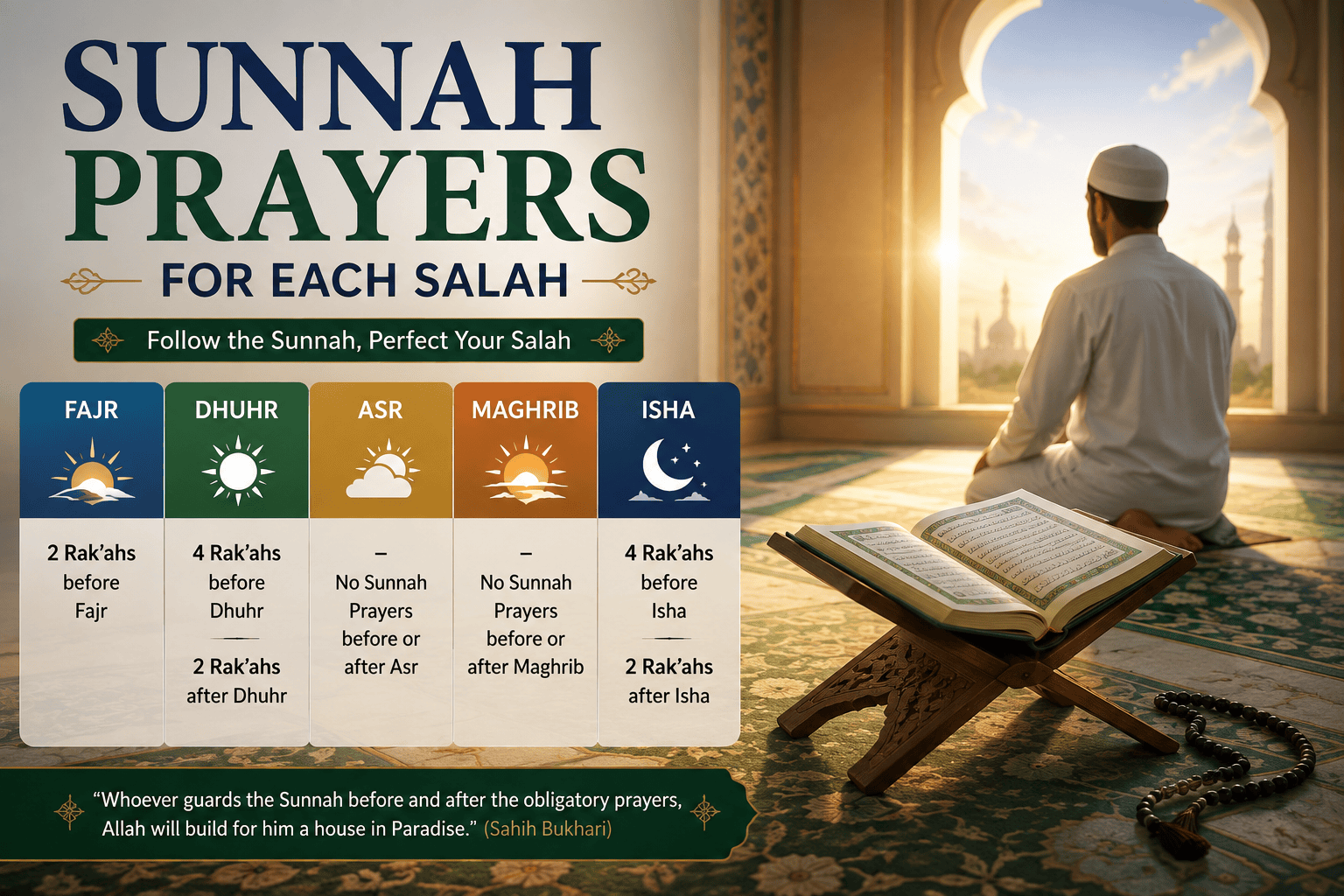
If you want to follow the Sunnah of the Prophet Muhammad ﷺ more closely in your daily worship, learning the Sunnah prayers for each salah is an excellent place to begin.
These voluntary prayers are performed around the five obligatory prayers and are known as Sunan al-Rawatib when they are regularly connected to the obligatory salah.
The commonly emphasized daily Sunnah prayers include 2 rak’ahs before Fajr, 4 before and 2 after Dhuhr, 2 after Maghrib, and 2 after Isha. A well-known hadith in Jami` al-Tirmidhi describes twelve Sunnah rak’ahs across the day and night in this pattern.
There are also additional voluntary prayers associated with the daily salah, including prayers before Asr and prayers between the adhan and iqamah. The exact number and legal status can differ among Islamic schools of thought, so it is useful to distinguish the regularly emphasized Sunnah prayers from additional voluntary salah.
Sunnah Prayers for Each Salah at a Glance
| Salah | Sunnah Prayer | Rak’ahs | When |
|---|---|---|---|
| Fajr | Sunnah before Fajr | 2 | Before the obligatory Fajr |
| Dhuhr | Sunnah before Dhuhr | 4 | Before the obligatory Dhuhr |
| Dhuhr | Sunnah after Dhuhr | 2 | After Dhuhr |
| Asr | Voluntary prayer before Asr | 4 | Before the obligatory Asr |
| Maghrib | Sunnah after Maghrib | 2 | After Maghrib |
| Isha | Sunnah after Isha | 2 | After the obligatory Isha |
| Isha/night | Witr | Varies by school and practice | After Isha and before Fajr |
The first six entries are based on well-established reports about the Prophet’s regular voluntary prayers, while the four before Asr are an additional recommended voluntary prayer rather than part of the twelve-rak’ah Rawatib pattern.
What Are Sunnah Prayers?
Sunnah prayers are voluntary prayers connected with the practice and example of the Prophet Muhammad ﷺ. They are not the same as the five obligatory salahs.
A particularly important category is Sunan al-Rawatib, meaning regular Sunnah prayers associated with the obligatory prayers. Reports from Ibn Umar and Aishah describe the Prophet ﷺ regularly praying voluntary rak’ahs before or after several obligatory prayers.
This distinction matters because Muslims may encounter different prayer schedules in books, mosques, or online resources. Some sources focus specifically on the twelve regular Rawatib, while others include additional voluntary prayers.
The goal is not simply to count rak’ahs. These prayers are an opportunity to follow the Prophet’s example and build consistency around the five daily salahs.
1. Sunnah Prayers for Fajr
2 Rak’ahs Before Fajr
The most widely emphasized Sunnah connected with Fajr is two rak’ahs before the obligatory Fajr prayer.
These two rak’ahs are performed after the beginning of Fajr time and before the fard prayer. A report from Aishah states that the Prophet ﷺ was particularly consistent with these two rak’ahs.
Their virtue is especially emphasized in Sahih Muslim. Aishah reported that the Prophet ﷺ said that the two rak’ahs at dawn are better than the world and everything in it.
Because of this strong emphasis, the Sunnah of Fajr deserves special attention even when someone is trying to establish a broader habit of Sunnah prayers.
Simple routine:
- Fajr time begins.
- Pray the 2 Sunnah rak’ahs.
- Pray the 2 obligatory Fajr rak’ahs.
The Sunnah prayer does not replace the obligatory Fajr prayer.
2. Sunnah Prayers for Dhuhr
Dhuhr has several regularly reported Sunnah prayers.
4 Rak’ahs Before Dhuhr
A report from Aishah in Sahih Muslim describes the Prophet ﷺ praying four rak’ahs before Dhuhr.
Another authentic report from Ibn Umar describes two rak’ahs before Dhuhr and two after it.
These reports help explain why Muslims may encounter different descriptions of the Sunnah before Dhuhr. Both two and four rak’ahs are reported in the hadith literature.
2 Rak’ahs After Dhuhr
The Prophet ﷺ is also reported to have prayed two rak’ahs after Dhuhr. Ibn Umar specifically reported observing two rak’ahs after the noon prayer with the Messenger of Allah ﷺ.
For someone following the twelve-rak’ah Rawatib arrangement, the commonly cited pattern is:
4 before Dhuhr + 2 after Dhuhr.
Jami` al-Tirmidhi records this arrangement among the twelve Sunnah rak’ahs prayed during the day and night.
3. Sunnah Prayers for Asr
The Asr prayer is different from the other prayers in the standard twelve-rak’ah Rawatib schedule.
4 Rak’ahs Before Asr
There is a recommended voluntary prayer of four rak’ahs before Asr. It is not included in the well-known twelve Rawatib rak’ahs, but it is supported by the broader Sunnah of performing voluntary prayer before the obligatory salah.
More generally, the Prophet ﷺ taught that there is voluntary prayer between the adhan and iqamah for whoever wishes to pray. Sahih al-Bukhari records this principle explicitly.
The four rak’ahs before Asr should therefore be understood as an additional recommended voluntary prayer, rather than automatically treating them as part of the twelve regular Rawatib.
A practical routine can be:
4 voluntary rak’ahs → 4 obligatory Asr rak’ahs.
Because terminology and rulings can differ between schools of fiqh, someone who follows a particular madhhab should follow its established guidance.
4. Sunnah Prayers for Maghrib
2 Rak’ahs After Maghrib
The Prophet ﷺ regularly prayed two rak’ahs after Maghrib.
Ibn Umar reported that he prayed two rak’ahs after the sunset prayer with the Messenger of Allah ﷺ, and Aishah also described two rak’ahs after Maghrib in her report about the Prophet’s voluntary prayers.
The basic sequence is:
3 obligatory Maghrib rak’ahs → 2 Sunnah rak’ahs.
These two rak’ahs are part of the twelve-rak’ah Rawatib pattern mentioned in the hadith of Aishah.
There can also be voluntary prayer between the adhan and iqamah, but it should not be confused with the regular two rak’ahs performed after Maghrib.
5. Sunnah Prayers for Isha
2 Rak’ahs After Isha
The Prophet ﷺ regularly prayed two rak’ahs after Isha.
Ibn Umar reported that he observed two rak’ahs after Isha with the Messenger of Allah ﷺ.
Aishah likewise described the Prophet ﷺ praying two rak’ahs after Isha when he returned to his home.
The basic sequence is:
4 obligatory Isha rak’ahs → 2 Sunnah rak’ahs → Witr or other voluntary night prayer.
What About Witr?
Witr is an important night prayer associated with the time after Isha and before Fajr. It is distinct from the two-rak’ah Sunnah after Isha.
Sahih Muslim records reports from Aishah that the Prophet ﷺ regularly performed Witr during the night and completed it before dawn.
The exact legal classification and method of Witr differ among the Islamic schools of jurisprudence. Therefore, it is best not to treat every discussion of Witr as identical to the Sunnah Rawatib.
The 12 Regular Sunnah Rak’ahs
One of the clearest ways to understand the daily Rawatib is to look at the twelve-rak’ah arrangement reported in hadith:
- 2 rak’ahs before Fajr
- 4 rak’ahs before Dhuhr
- 2 rak’ahs after Dhuhr
- 2 rak’ahs after Maghrib
- 2 rak’ahs after Isha
That makes 12 rak’ahs.
Jami` al-Tirmidhi records this arrangement from Aishah, while Sahih Muslim records the virtue of maintaining twelve voluntary rak’ahs during the day and night.
Sahih Muslim also reports Umm Habibah’s narration that whoever prays twelve voluntary rak’ahs in a day and night will have a house built for them in Paradise.
This should be understood as a promise reported in the hadith, not as a guarantee of a particular personal outcome beyond what the authentic prophetic narration states.
Why Do Some Lists Show 10 Sunnah Rak’ahs?
You may find another authentic-looking schedule that lists 10 regular rak’ahs:
- 2 before Dhuhr
- 2 after Dhuhr
- 2 after Maghrib
- 2 after Isha
- 2 before Fajr
Sahih al-Bukhari records Ibn Umar’s report of ten rak’ahs from the Prophet ﷺ in this arrangement.
This does not mean that one hadith must be rejected because another report mentions twelve. Rather, the hadith literature preserves different descriptions of the Prophet’s voluntary prayer practice.
For Dhuhr in particular, Aishah reported four rak’ahs before the obligatory prayer, while Ibn Umar reported two before and two after.
This is one reason Muslims may see different Rawatib schedules in Islamic resources.
A Simple Daily Sunnah Prayer Schedule
For someone who wants a straightforward routine based on the twelve-rak’ah Rawatib arrangement, the day can look like this:
Fajr
- 2 Sunnah before Fajr
- 2 fard
Dhuhr
- 4 Sunnah before Dhuhr
- 4 fard
- 2 Sunnah after Dhuhr
Asr
- 4 fard
- Additional voluntary prayer before Asr may also be performed
Maghrib
- 3 fard
- 2 Sunnah after Maghrib
Isha
- 4 fard
- 2 Sunnah after Isha
- Witr according to one’s school and practice
This schedule separates the obligatory prayers from the regular Sunnah prayers and additional voluntary worship.
Sunnah Mu’akkadah vs. Other Voluntary Prayers
The term Sunnah Mu’akkadah is commonly used in Islamic jurisprudence for a Sunnah practice that the Prophet ﷺ regularly maintained and strongly emphasized.
However, the precise classification of individual Sunnah prayers can vary among schools of fiqh.
It is therefore useful to distinguish three broad ideas:
Regular Sunnah prayers: prayers consistently connected with the obligatory salah.
Additional Sunnah or recommended prayers: voluntary prayers supported by reports but not necessarily included in the twelve Rawatib.
Nafl: voluntary prayer offered for additional worship beyond the obligatory salah.
This terminology helps prevent confusion when different Islamic books or teachers use slightly different classifications.
What If You Cannot Pray Every Sunnah Prayer?
If you are building the habit gradually, prioritize the five obligatory salahs. The Sunnah prayers are additional acts of worship and should not become a reason to neglect the fard prayers.
Once your obligatory prayers are established, you can build consistency with the Sunnah prayers one prayer at a time.
For example:
- Start by consistently praying the 2 Sunnah rak’ahs before Fajr.
- Add the Sunnah prayers around Dhuhr.
- Add the 2 after Maghrib.
- Add the 2 after Isha.
- Then incorporate additional voluntary prayers as appropriate.
The purpose is consistent worship, not simply achieving a number on a checklist.
Common Questions About Sunnah Prayers
How many Sunnah rak’ahs are there in the five daily prayers?
A commonly cited Rawatib schedule contains 12 rak’ahs: 2 before Fajr, 4 before Dhuhr, 2 after Dhuhr, 2 after Maghrib, and 2 after Isha. Other authentic reports describe 10 regular rak’ahs, particularly by reporting two rather than four before Dhuhr.
Are Sunnah prayers obligatory?
No. The Sunnah prayers discussed here are voluntary prayers and are distinct from the five obligatory salahs. Their precise jurisprudential status can vary depending on the prayer and school of fiqh.
Which Sunnah prayer is especially emphasized?
The two rak’ahs before Fajr have exceptional emphasis in the hadith. Sahih Muslim records the Prophet ﷺ describing them as better than the world and everything in it.
Are four rak’ahs before Dhuhr or two rak’ahs before Dhuhr Sunnah?
Both arrangements are supported by hadith reports. Aishah reported four before Dhuhr, while Ibn Umar reported two before and two after Dhuhr.
Is Witr one of the twelve Rawatib prayers?
No. Witr is a separate night prayer. It is performed after Isha and before Fajr, and its detailed ruling and method differ among the schools of Islamic jurisprudence.
Final Takeaway
Learning the Sunnah prayers for each salah can make the daily prayer routine easier to understand and follow. The commonly cited twelve-rak’ah Rawatib schedule consists of 2 before Fajr, 4 before Dhuhr, 2 after Dhuhr, 2 after Maghrib, and 2 after Isha.
Authentic reports also describe a ten-rak’ah arrangement and additional voluntary prayers, showing that the Prophet’s ﷺ voluntary worship included some variation. You can review the relevant Hadith reports on Sunnah.com for further details.
For beginners, the best approach is to protect the five obligatory salahs first and then establish the Sunnah prayers consistently. If you follow a particular madhhab, consult a qualified scholar or trusted fiqh resource for school-specific details, especially concerning classifications, timing, and how missed Sunnah prayers are handled.

The Faith & Tradition Research Team helps develop and organize resources relating to religious traditions represented on Prayerium. Our focus is on researching established practices, terminology, historical context, and traditional prayers while presenting different faith traditions with care and respect.