
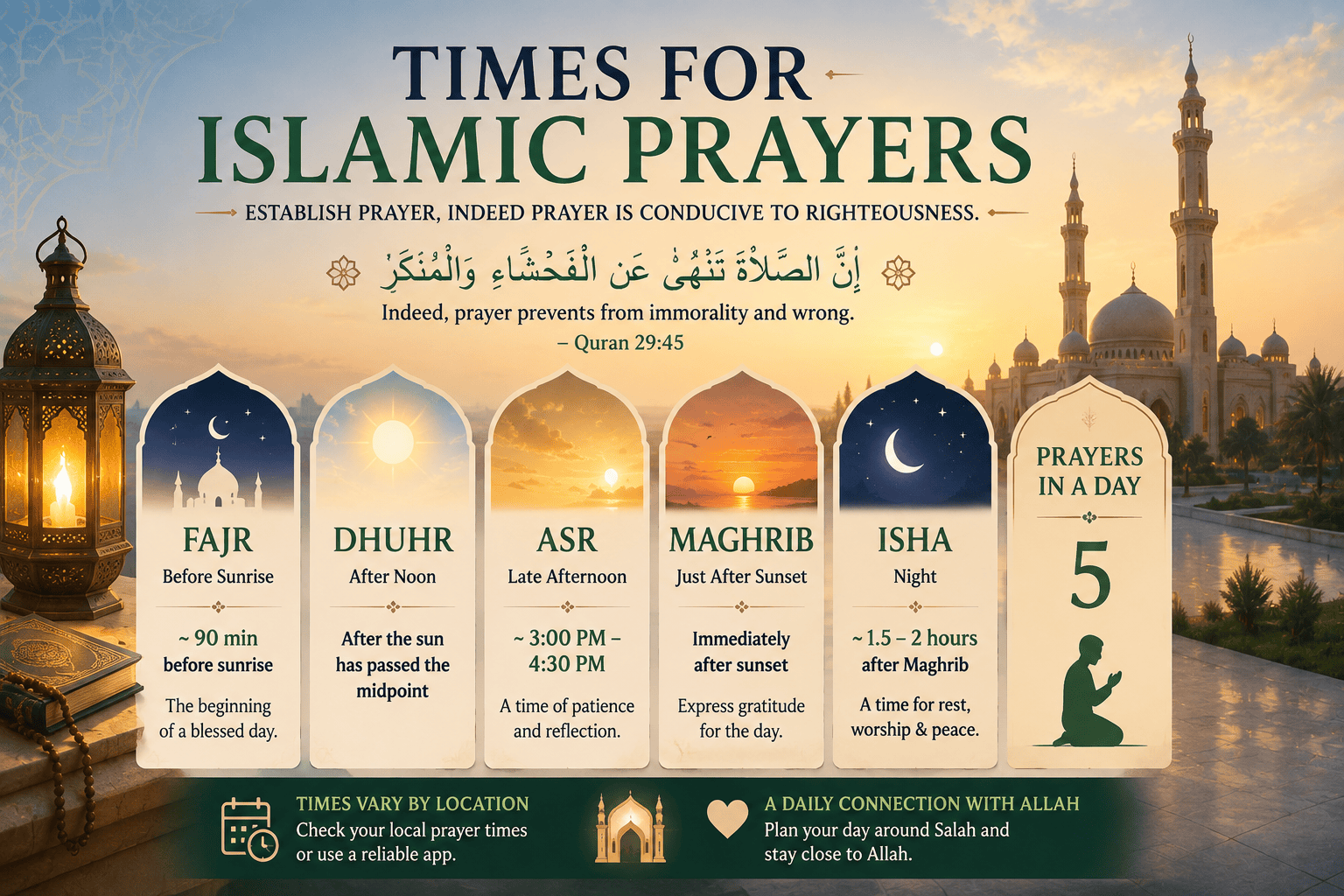
Muslims perform five obligatory prayers each day: Fajr, Dhuhr, Asr, Maghrib, and Isha. Their times are connected to the movement of the sun, so the exact clock time changes according to location, date, season, and the calculation method used.
The Quran emphasizes that prayer is prescribed at appointed times. For Muslims in the United States, this means there is no single nationwide schedule for Islamic prayers. Fajr in New York, for example, will not occur at the same clock time as Fajr in Los Angeles.
This guide explains what each prayer time means, how the daily schedule works, and how to understand local prayer timetables.
The Five Daily Islamic Prayer Times
| Prayer | Arabic Name | General Time |
|---|---|---|
| Fajr | الفجر | From true dawn until sunrise |
| Dhuhr | الظهر | After the sun passes its highest point |
| Asr | العصر | During the afternoon, after Dhuhr |
| Maghrib | المغرب | Immediately after sunset |
| Isha | العشاء | After twilight disappears into the night |
These are not simply five convenient points on a clock. Rather, each salah has a defined time window connected to natural signs such as dawn, the sun’s position, sunset, and twilight. The Prophet Muhammad’s teachings provide further details about these prayer periods.
1. Fajr Prayer Time
Fajr is the first of the five daily prayers. It begins with true dawn, before the sun rises, and its time ends at sunrise.
Because Fajr is based on dawn rather than a fixed clock hour, its timing changes considerably throughout the year. In many parts of the United States, Fajr can be very early during summer and considerably later during winter.
The Quran specifically mentions the dawn prayer and describes its recitation as witnessed.
For anyone checking a local prayer schedule, the important distinction is:
Fajr time is not the same as sunrise time.
A timetable may therefore show both Fajr and sunrise as separate entries.
2. Dhuhr Prayer Time
Dhuhr is the midday prayer. Its time begins after the sun has passed its meridian, meaning the point when the sun has reached its highest position for that day.
The beginning and ending of Dhuhr are therefore determined astronomically rather than by a universal clock time.
The Quran describes the period beginning with the sun’s decline and continuing toward the darkness of night, while Prophetic teachings provide more specific details about the individual prayer windows.
For American Muslims, Dhuhr may occur around the middle of the day, but the exact time changes daily and differs from one city to another.
3. Asr Prayer Time
Asr is the afternoon prayer. Its timing follows Dhuhr and is determined partly by the position and length of shadows.
There are recognized differences among Islamic schools of jurisprudence concerning the calculation of Asr. For that reason, two prayer calendars for the same city can sometimes display slightly different Asr times.
A Prophetic narration describes different shadow measurements associated with the beginning of Asr and explains that the prayer period extends within a defined window.
Therefore, if your local mosque and a prayer app show slightly different Asr times, check which Asr calculation method each one follows rather than assuming one schedule is automatically incorrect.
4. Maghrib Prayer Time
Maghrib begins immediately after sunset.
This makes Maghrib one of the easiest prayer times to understand from a natural sign: when the sun has set, the Maghrib period begins.
However, the exact clock time changes every day. In the United States, the difference can be especially noticeable between summer and winter. It also varies significantly between states and cities.
The Prophetic description of the prayer times places Maghrib after sunset and continues its window until twilight disappears.
Because of this, a prayer timetable should be checked for the specific location and date rather than relying on a fixed daily hour.
5. Isha Prayer Time
Isha is the night prayer. Its time begins after the evening twilight has disappeared.
The available Prophetic descriptions establish a defined period for Isha during the night.
Like the other prayers, Isha does not have one universal clock time. Its timing changes with sunset, twilight, season, and geographic location.
This can become particularly important at higher latitudes, where twilight can remain for an unusually long period during parts of the year.
Why Islamic Prayer Times Change Every Day
Islamic prayer times are based on solar movements, not fixed clock times. Consequently, several factors affect the timetable:
- Location: Latitude and longitude affect sunrise, sunset, and the sun’s position.
- Date: The length of daylight changes throughout the year.
- Season: Summer and winter can produce substantial differences in prayer times.
- Calculation method: Different recognized methods can produce variations, especially for Fajr, Isha, and Asr.
- Geographic latitude: Locations farther from the equator can experience unusual twilight conditions.
For example, a prayer timetable for New York cannot simply be copied for Chicago, Houston, Seattle, or Los Angeles. Each location has its own astronomical conditions.
Current prayer-time services in the United States therefore commonly provide schedules based on a selected city and calculation method. One example of a U.S. timetable shows separate Fajr, Dhuhr, Asr, Maghrib, and Isha times and identifies the calculation method used.
How to Find Accurate Islamic Prayer Times in the United States
If you are looking for today’s Islamic prayer times, use a timetable that allows you to select your exact city.
A reliable approach is to:
- Select your city or nearest appropriate location.
- Check the date because prayer times change daily.
- Review Fajr, Dhuhr, Asr, Maghrib, and Isha separately.
- Check the calculation method used by the timetable.
- Compare with your local mosque when necessary, particularly if your community follows a specific calculation method.
- Pay special attention to Fajr and Isha in areas where twilight conditions can create larger variations.
This is more accurate than using a generic national schedule for the entire United States.
Why Prayer Times Matter in Islam
Salah is one of the central practices of Islam. Islamic Relief describes Salah as the ritual prayer performed five times each day and identifies it as one of the Five Pillars of Islam.
The importance of timing is also directly reflected in the Quran. Surah An-Nisa 4:103 describes prayer as a duty upon believers at appointed times.
The schedule gives the Muslim day a recurring structure: dawn begins with Fajr, midday brings Dhuhr, afternoon brings Asr, sunset marks Maghrib, and nighttime concludes with Isha. Rather than treating prayer as an occasional practice, the five daily salah create regular opportunities to remember and worship Allah.
Islamic Prayer Times vs. Sunnah and Nafl Prayers
It is also helpful to distinguish the five obligatory prayers from additional prayers.
The five obligatory salah are:
- Fajr
- Dhuhr
- Asr
- Maghrib
- Isha
There are also Sunnah and Nafl prayers, which are voluntary or specially emphasized acts of worship depending on the prayer and Islamic legal tradition.
For example, additional prayers can be performed around some of the obligatory prayers, while Duha is a voluntary prayer performed during the daytime. Tahajjud is another voluntary prayer associated with the night.
These should not be confused with the five obligatory daily prayers.
What If Two Prayer Timetables Show Different Times?
Small differences do not necessarily mean that one timetable is wrong.
Prayer calculations can vary because of:
- Different Fajr and Isha angles
- Different Asr shadow conventions
- Geographic coordinates
- Calculation methods
- Rounding
- Local mosque preferences
For example, a published U.S. prayer timetable may explicitly identify its calculation method, showing why knowing the method can be useful when comparing schedules.
If the difference is important for your practice, follow the method recommended by your local mosque or a trusted Islamic authority you follow.
Frequently Asked Questions
What are the five Islamic prayer times?
The five daily prayers are Fajr, Dhuhr, Asr, Maghrib, and Isha. Each has its own prescribed time window.
What time is Fajr?
Fajr begins at true dawn and ends at sunrise. Its exact clock time changes according to location and date.
What time is Maghrib?
Maghrib begins after sunset. Therefore, its clock time changes throughout the year and differs between locations.
Why are Islamic prayer times different from city to city?
Prayer times depend on astronomical conditions. Since sunrise, sunset, and the sun’s position differ by location, prayer times also differ.
Why do different prayer apps show different Asr times?
One major reason is the calculation method used for Asr. Different Islamic legal traditions may use different shadow-length criteria.
Are prayer times the same throughout the United States?
No. Prayer times vary considerably between U.S. cities because of differences in latitude, longitude, sunrise, sunset, and seasonal daylight.
Final Thoughts
Understanding the times for Islamic prayers becomes much easier when you remember that salah follows the sun rather than a fixed nationwide clock. Fajr begins at dawn, Dhuhr follows the sun’s midday decline, Asr occurs in the afternoon, Maghrib begins after sunset, and Isha follows the disappearance of evening twilight.
For Muslims in the United States, the best practice is to use a prayer timetable based on the specific city, date, and calculation method.
You can check IslamicFinder’s prayer times for location-based schedules and different calculation methods. This approach provides a more meaningful and accurate schedule than relying on one fixed time for everyone.

The Faith & Tradition Research Team helps develop and organize resources relating to religious traditions represented on Prayerium. Our focus is on researching established practices, terminology, historical context, and traditional prayers while presenting different faith traditions with care and respect.